Role Management
Role management is used to maintain user permission sets. One user can bind multiple characters; Within the role, API permissions, menu permissions, and button permissions can be configured simultaneously. When permissions are insufficient, users may not see menus, buttons, or be denied access to interfaces.
First, look at terminology
| terminology | on-site understanding |
|---|---|
| role | a set of permissions, For example, "read-only monitoring," "operation and maintenance," and "project administrator." |
| API permissions | Background interface call permissions. If the page button is visible but API permissions are missing, the operation may still fail. |
| Menu permissions | Visible permissions for left navigation and page entrances. Without menu permissions, users usually cannot see the page. |
| Button Permissions | Operation permissions for adding, editing, deleting, exporting, authorizing, and other buttons within the page. |
| Authorization | The process of checking API, menu, and button permissions for roles. |
| Least permissions | Only grant the necessary permissions to complete the work. Don't configure ordinary users as super administrators in the production environment. |
Page Entry
After logging into GatewayRuntime Web, enter "System Administration → Role Management."
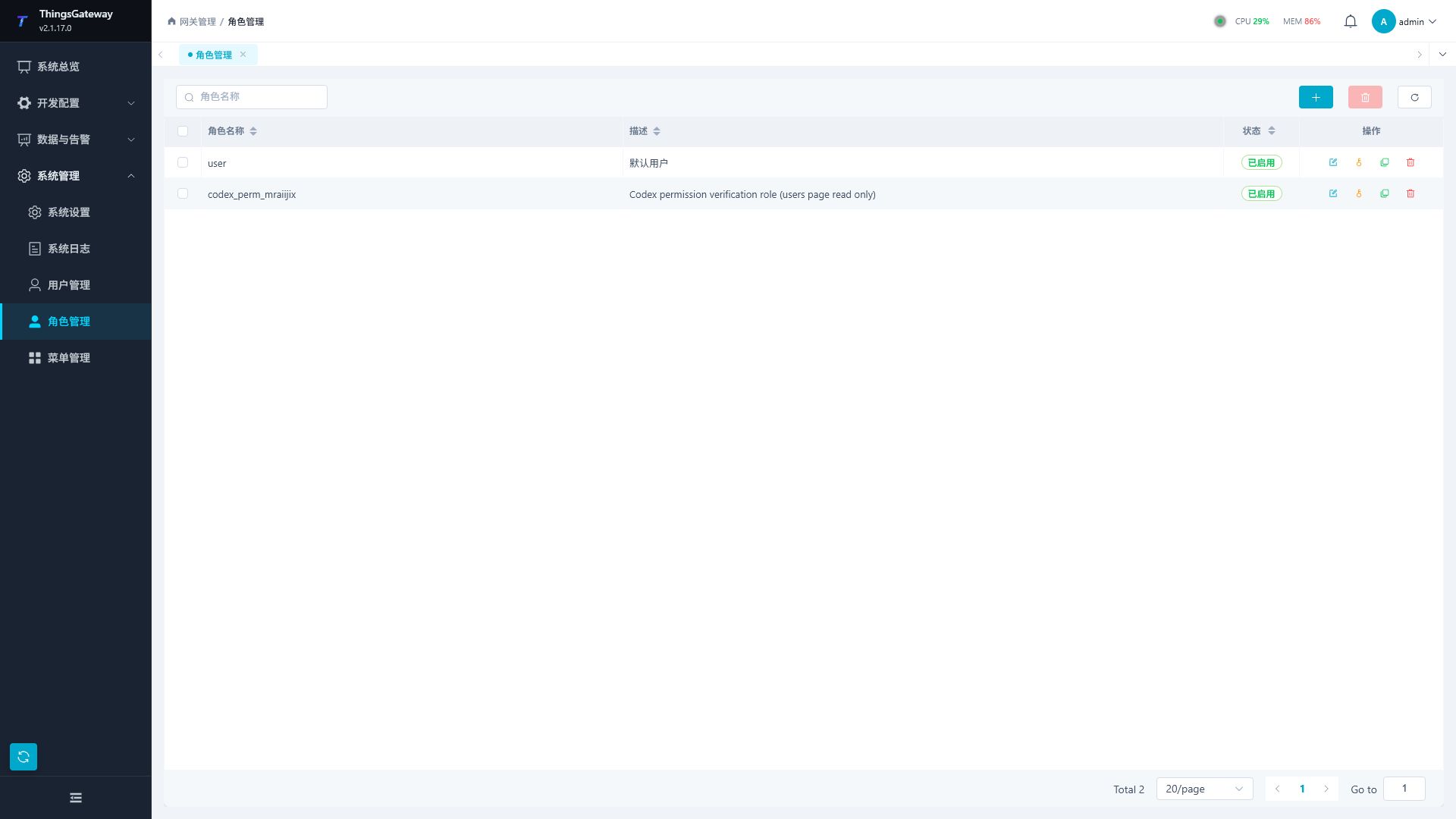
Page Structure
| Area | Description |
|---|---|
| Role Name Search | Filter List by Role Name. |
| Tool buttons | are Add, Batch Delete, and Refresh in order. To delete in bulk, you need to check the character first. |
| Character List | Displays character names, descriptions, enabled statuses, and action buttons. |
| Operations column | includes editing, authorizing, copying, and deleting. The Super Administrator role cannot be deleted. |
List Fields
| Fields | Description |
|---|---|
| Role Name | Role display name, which is also the name the user sees when assigning roles. |
| Description: | Role Description, such as "Operation and Maintenance," "Read-Only Monitoring," "Project Administrator." |
| Status | Enabled or Disabled. Disabling characters will no longer grant permissions. |
| Operations | Edit, authorize, copy, delete. |
Add and Edit Characters
Click the Add button, or click the Edit button in the character row to open the Character Configuration drawer.
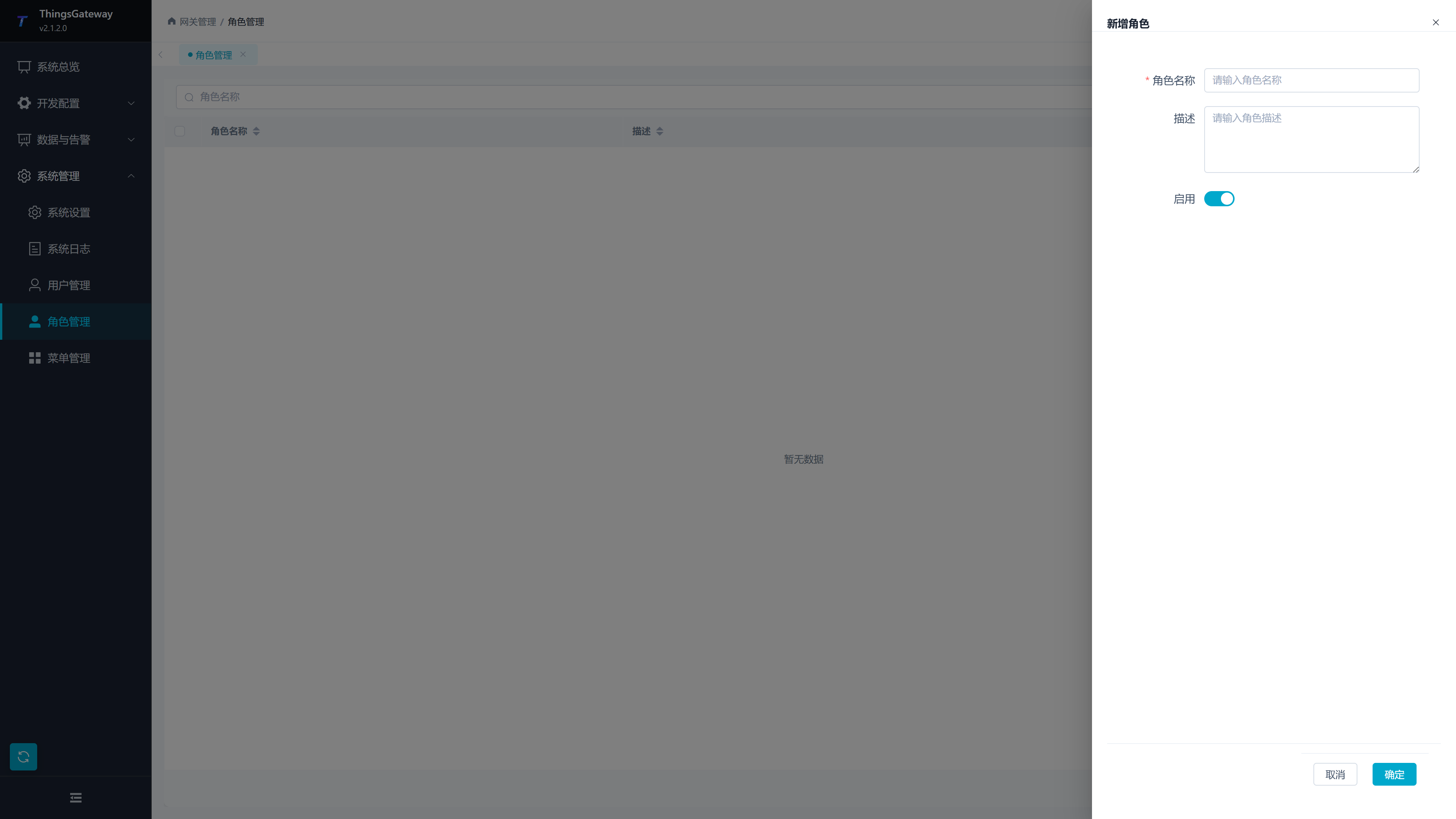
| Configuration Items | Description |
|---|---|
| Role Name | Required. It is recommended to name according to job responsibilities and not use personal names as long-term character names. |
| Description | optional. Explain the role to which it applies, permission boundaries, and maintenance considerations. |
| Enable | to check if the character is active. This switch can be turned off when temporarily disabling a character. |
Authorization Drawer
Click the authorization button in the role row to open the "Role Authorization" drawer. The drawer contains tabs for "API Authorization" and "Menu Button Authorization," with options at the bottom for "Cancel," "Preview Difference," and "Save."
API Authorization
Which service interfaces can the API authorization control role call. Even if the page buttons are visible, if the corresponding API permissions are missing, interface calls may still fail.
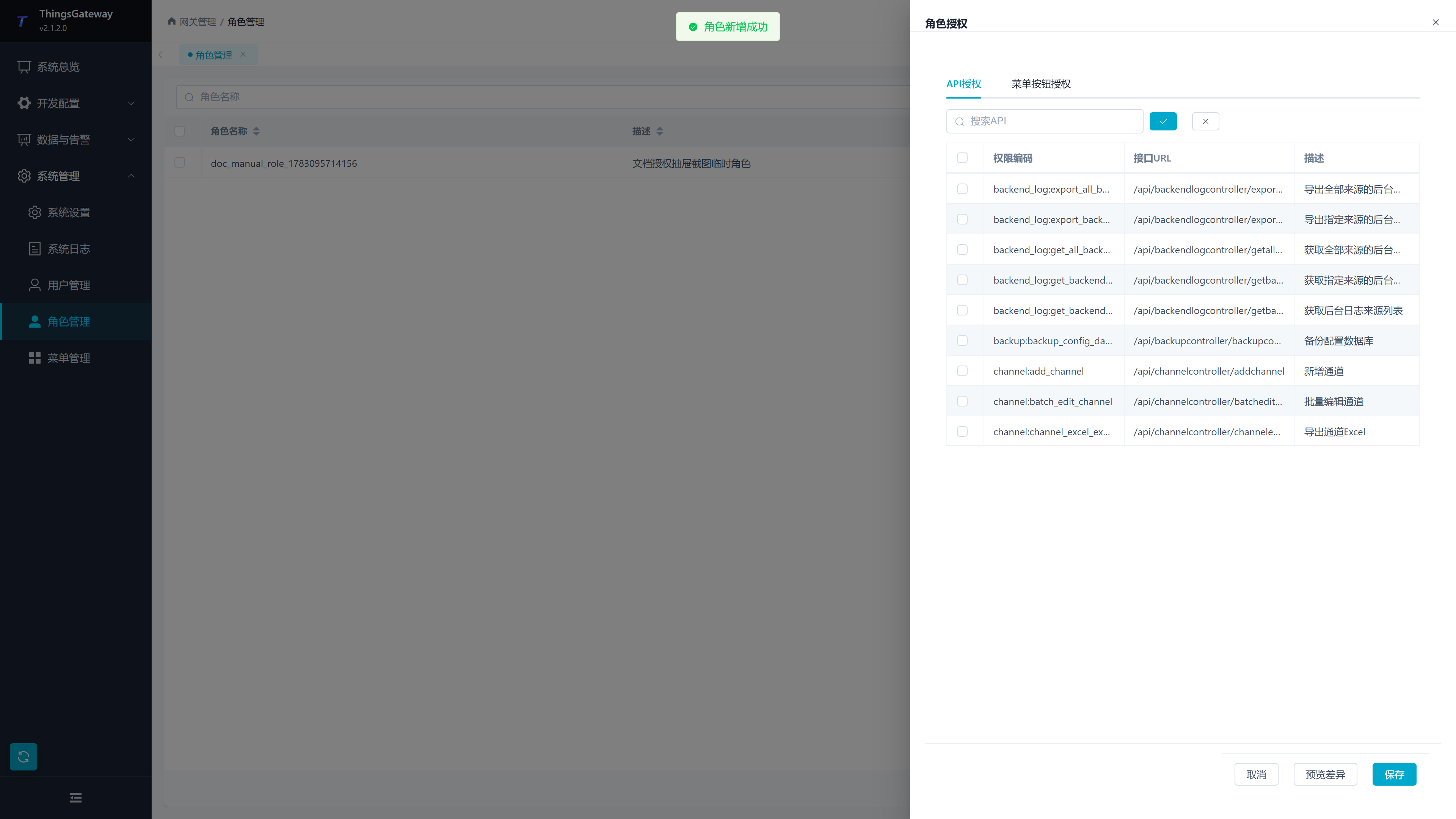
| Area | Description |
|---|---|
| Search API | Filter the list of interfaces by permission code, interface URL, or description. |
| Select All | Select all interfaces in the current API permission list. |
| Clear | Clear current API permission selections. |
| Permission encoding | Business permission identification, such as variable writing, user maintenance, log export, etc. |
| Interface URL | The interface path corresponding to the current permission. |
| Description | Interface Purpose Description. |
API authorization is suitable for minimizing allocation by function. For example, read-only monitoring roles usually only retain query interfaces; The operations role can add interfaces for write, restart, import/export, and log export.
Menu Button Authorization
Menu button authorization controls which menus users can see and which buttons within the menus can be operated.
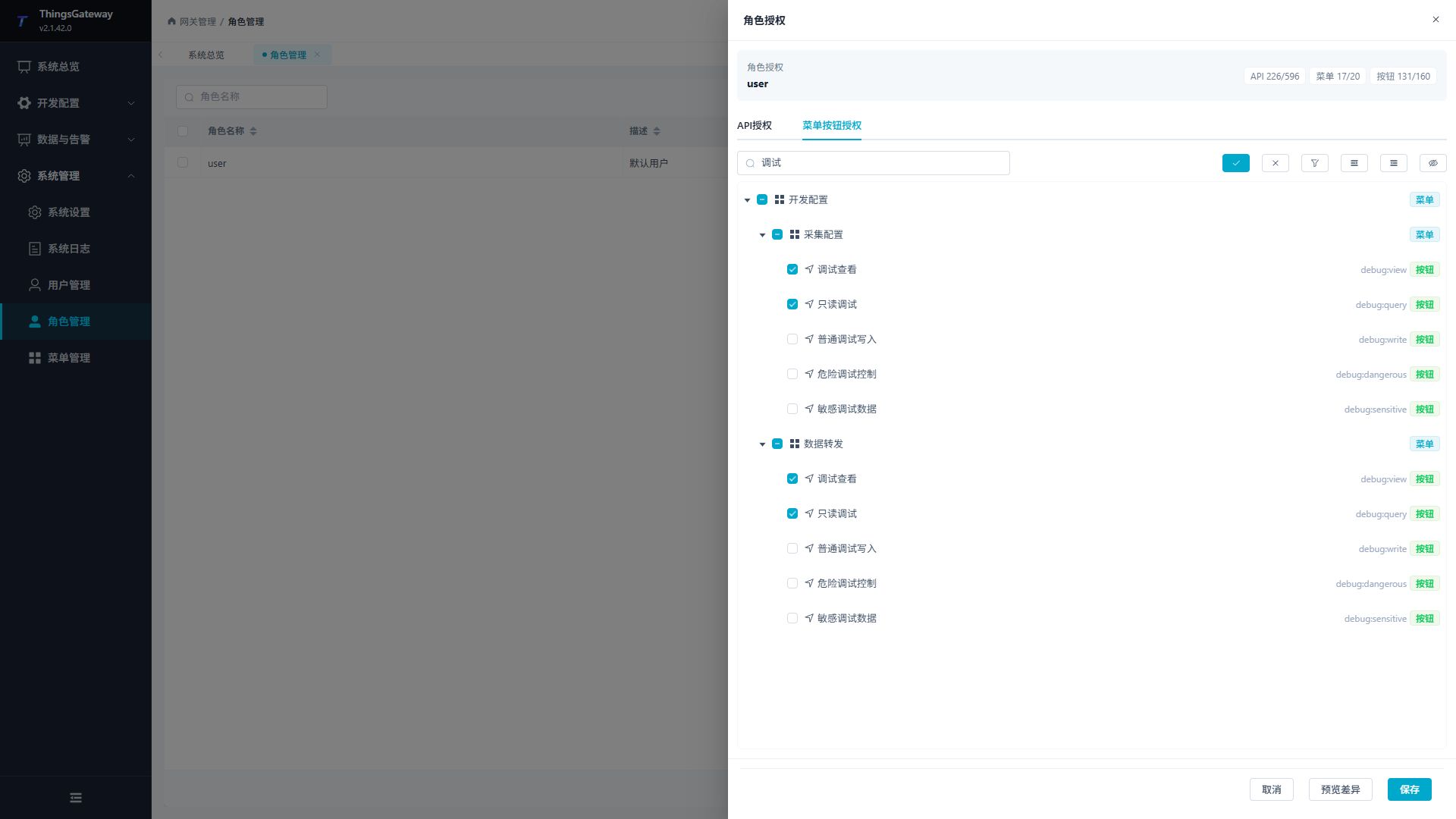
| Area | Description |
|---|---|
| Search for menus or buttons | Filter permission trees by menu name or button name. |
| Select All | Select all menu and button nodes. |
| Clear | Clear all menu and button selections. |
| Menu Node | controls whether the left navigation menu and page entry are visible. |
| Button nodes | Control whether buttons for adding, editing, deleting, exporting, authorizing, etc. are visible on the page. |
In the authorization tree, "menus" and "buttons" are identified with different tags. When checking menus, check the buttons below to avoid users accessing the page but missing necessary buttons.
Debug Permission Levels
The Collection Configuration and Data Forwarding menus each provide five independent debug button permissions. They are split by risk, so a role can receive view or query access without also receiving writes or controls.
| Button permission | API permission code | Scope |
|---|---|---|
| Debug View | debug:view | View the Debug tab, object overview, runtime state, and redacted summaries. |
| Read-only Debug | debug:query | Perform reads, node browsing, state queries, and read-only diagnostics. |
| General Debug Write | debug:write | Write ordinary points, publish messages, maintain subscriptions, and run low-risk protocol commands. |
| Dangerous Debug Control | debug:dangerous | Start or stop PLCs, reset equipment, move robots, perform batch I/O, send arbitrary commands, delete datasets, or disconnect clients. |
| Sensitive Debug Data | debug:sensitive | View certificate trust information, identity information, and other sensitive debugging content. |
When authorizing, first select the corresponding debug buttons under Menu Button Authorization, then verify the same codes under API Authorization. The default user role contains only Debug View and Read-only Debug; the other three permissions must be granted by separate roles.
Recommended role split:
| Role | Suggested debug permissions |
|---|---|
| Read-only Debug | Debug View and Read-only Debug. |
| General Write | Read-only Debug plus General Debug Write. |
| Dangerous Control | Add Dangerous Debug Control for approved equipment-maintenance staff; do not include Sensitive Debug Data by default. |
| Sensitive Data Review | Add Sensitive Debug Data for the business need; do not include writes or dangerous controls by default. |
Do not select all debug permissions merely to make one button available. Dangerous controls and sensitive data are separate responsibilities and should be approved, granted, and audited separately.
Preview Differences and Save
After clicking "Preview Differences," the bottom of your drawer will display the statistics for this permission adjustment.
| Difference Item | Description |
|---|---|
| Add Menu / Cancel Menu | The number of menu permissions that will be added or canceled after this save. |
| Add button / Cancel button | Number of button permissions added or canceled after this save. |
| Add API / Cancel API | The number of interface permissions that will be added or removed after this save. |
After confirming the discrepancies, click "Save". After saving, logged-in users usually need to refresh the page or log in again to see the latest menus, buttons, and interface permission effects.
Copy Character
Click the copy button in the character row to create a new character based on an existing one. Copying is suitable for the following scenarios:
| Scenarios | Suggestions |
|---|---|
| Create similar responsibilities | Copy existing roles first, Further increase and decrease permissions. |
| Temporary Authorization | After copying frequently used roles, add a separate temporary permission, which can be disabled or deleted after completion. |
| Permission Comparison | After copying, confirm the adjustment scope via "Preview Differences." |
After copying a character, immediately modify the character name and description to avoid confusion between multiple roles' uses.
Common Role Suggestions
| Role Types | Permission Suggestions |
|---|---|
| Read-only monitoring | read-only APIs and menus for system overview, data queries, real-time alarms, and log queries. |
| Operations and maintenance personnel | On top of read-only monitoring, permissions such as variable writing, device debugging, log export, and runtime restart are added. |
| Configure administrators | Collect configurations, data forwarding, scripts, nodes, rules, and plugin maintenance permissions. |
| Security Administrator | User management, role management, menu management, audit log permissions. |
Usage Notes
| Scenarios | Recommended |
|---|---|
| Super Administrator | Super Administrator has the highest privileges, so account sharing should be restricted, and login audits should be checked regularly. |
| API and button inconsistency | If only the button is authorized but the API is not authorized, page operations may fail; If only the API is authorized but the button is not authorized, users may not be able to trigger it from the page. |
| Delete Role | Before deleting, check the user's binding relationship to avoid having no available permissions after logging in. |
| Batch deletion | Only performs on regular roles that are not used as deleted; super administrator roles cannot be deleted. |
| Permission Adjustment Audit | View audit records in the system log after important permission adjustments. |