YaskawaMemobusMaster
Purpose
YaskawaMemobusMaster reads and writes Memobus TCP or UDP addresses and provides dedicated random-word diagnostics.
Open the plugin
Enter "Development Configuration → Collection Configuration", create a device and select "YaskawaMemobusMaster" in "Collection Plugin".
Supported channels and data types
| Channel type | Pre-configuration check |
|---|---|
| TCP Client | Confirm network reachability of the device IP, port, and gateway to the device. |
| UDP | Confirm the local binding address, port and firewall rules, and check the source of the packet. |
Optional data types: Boolean, Int16, UInt16, Int32, UInt32, Int64, UInt64, Float, Double, String
Plugin properties
Protocol parameters
| Setting | Description |
|---|---|
| Target CPU number | Default: 2; Range: 0~15; Fill in: text input. Sets the target CPU number used for protocol communication. |
| Source CPU number | Default: 1; Range: 0~15; Fill in: text input. Sets the source CPU number used for protocol communication. |
Request packing
| Setting | Description |
|---|---|
| Maximum number of bits to pack | Default: 2000; Range: 1~65535; Fill in: digital input. Set the maximum number of bit packets used for a single read, write or group packet. |
Address rules
- Memobus bit address: C0 is a writable standard coil, X0 is a read-only standard input bit; the M/G/I/O/S sign bit must explicitly use the WORD. bit number, such as M100.3.
- Memobus WORD address: H0 is a writable standard holding register, R0 is a read-only standard input register, EH0 is a writable extended holding register, EI0 is a read-only extended input register; M/G is a writable symbol WORD, and I/O/S is read-only.
- Address values are all decimal; you can use to=0..15;from=0..15; to override the default CPU route.
- Dynamic commands support EH discrete WORD random read and write, and M/G/I/O/S discrete WORD random read; the same requested address must use the same CPU route.
- A maximum of 2044 WORD can be read and 2043 WORD can be written at a time; TCP and UDP use the same protocol core, and the UDP datagram must contain exactly one frame.
Special methods
| Method | Purpose | Parameters |
|---|---|---|
| ReadRandomExtendedWordsAsync | Random read extended WORD | addresses=to=3;from=1;EH0,to=3;from=1;EH10 |
| WriteRandomExtendedWordsAsync | Random write extended WORD | addresses=EH0,EH10; hexWords=1234,ABCD |
| ReadRandomSymbolicWordsAsync | Randomly read symbols WORD | addresses=M0,G10,I20,O30,S40 |
Write, start/stop, reset, load, delete or control methods will change the status of field devices. Before execution, confirm that the equipment is in an operable state and prepare for stop or rollback measures.
Functions
| Function | Purpose |
|---|---|
| Read standard WORD or bit | Read a confirmed Memobus area and compare it with the controller value. |
| Read random extended or symbolic WORDs | Read multiple addresses in one request. All addresses in one request must use the same CPU route. |
| Write random extended WORDs | Write hexadecimal WORD values to EH addresses. Use only an approved test area. |
| Messages | Inspect TCP/UDP frames, route errors, and device responses. |
Device debug
Enter "Development Configuration → Collection Configuration", select the current device and click "More Functions", then open "Debug".
Dedicated debugging page
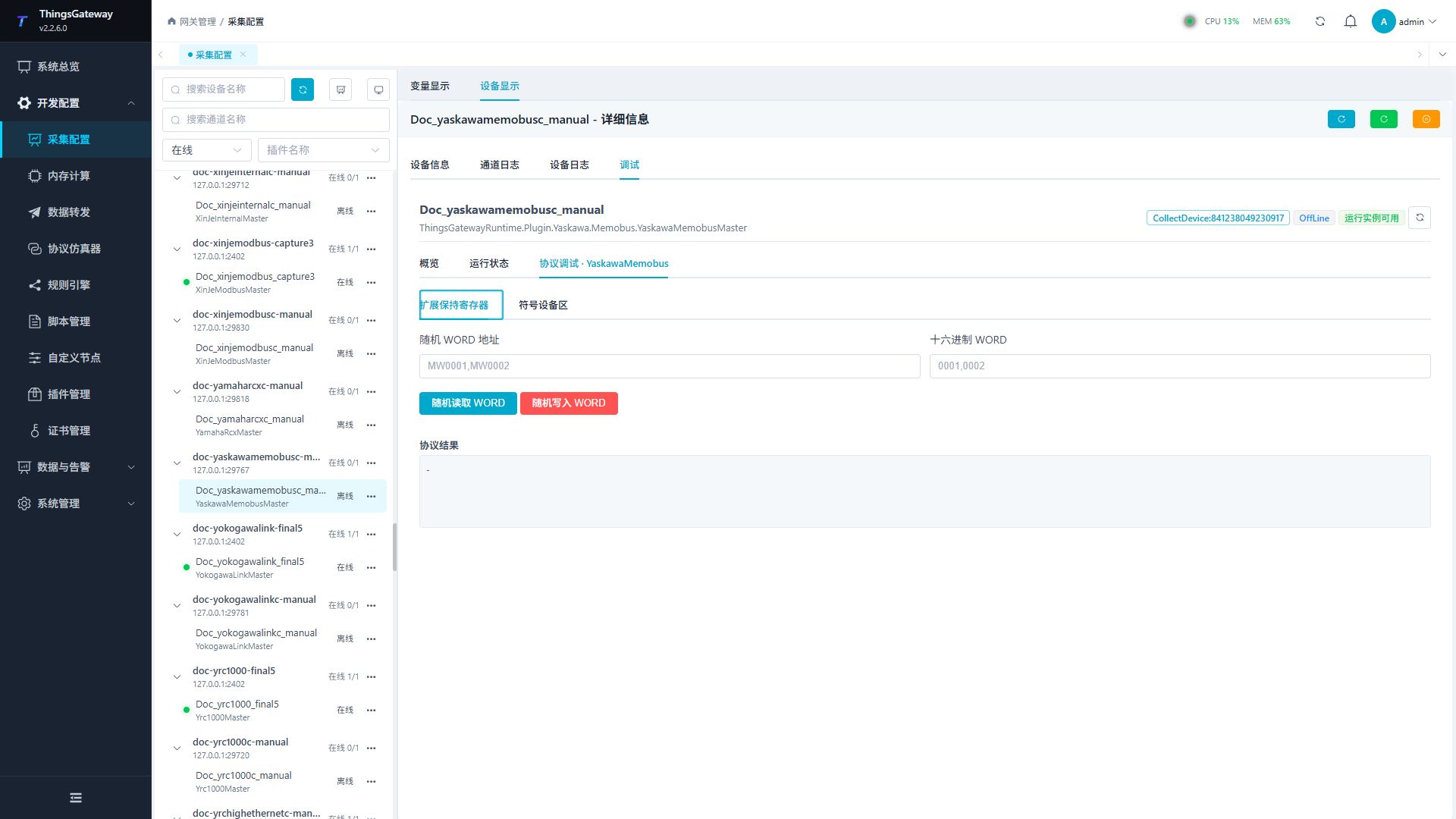
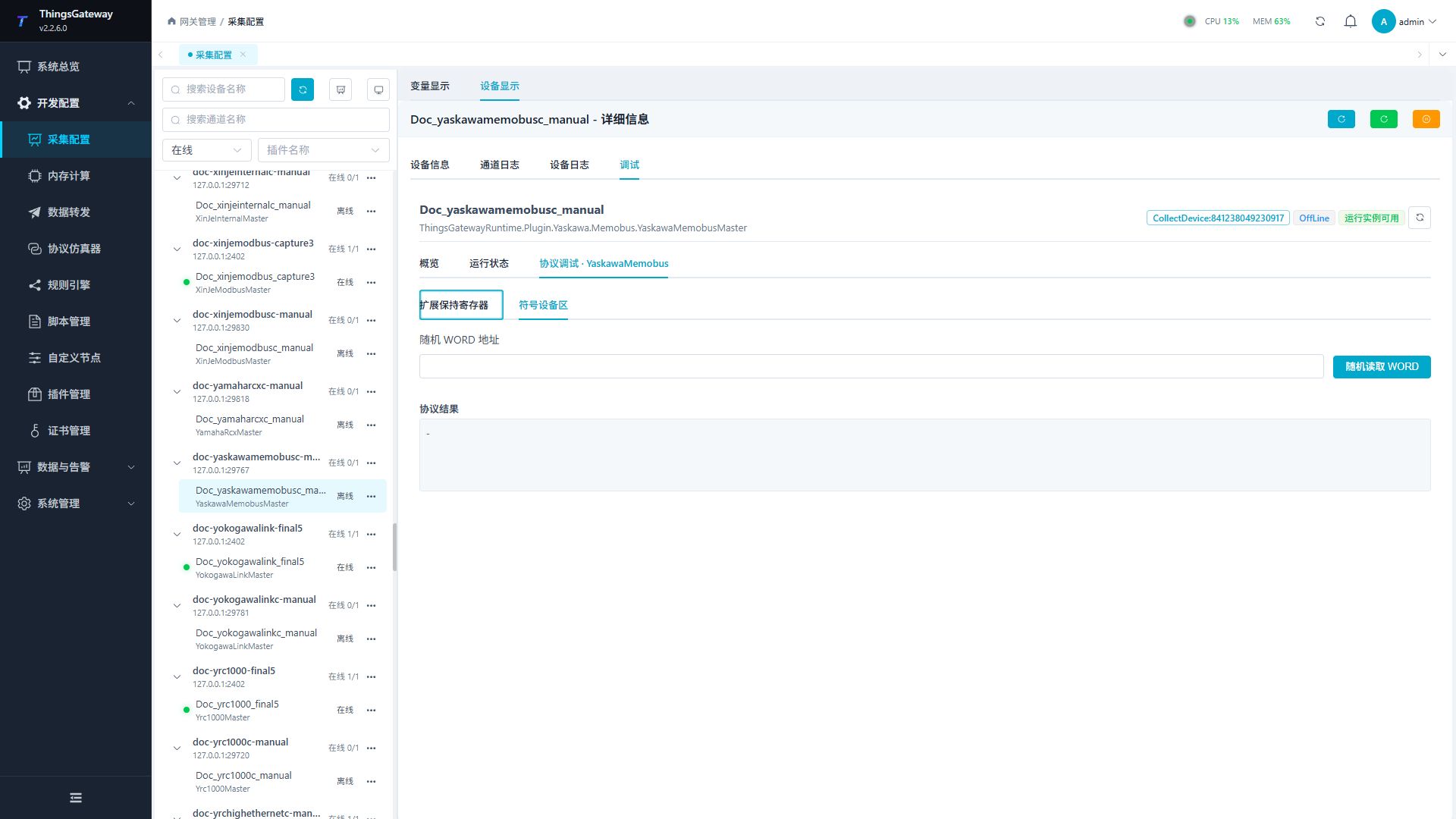
Use the extended-holding-register panel for EH addresses and the symbolic-device panel for M/G/I/O/S addresses.
Debugging notes
The symbol register remains read-only first; the address and hexadecimal word are checked before writing to the extended register, and a second confirmation is completed.
Verify the configuration
- Read a standard WORD such as
H0orR0and compare it with the controller. - Read
EH0,EH10on the extended-register panel and confirm the sametoandfromroute is used. - Read known
M0,G10,I20,O30,S40symbolic WORDs; treat I/O/S as read-only. - With UDP, confirm that each datagram contains exactly one frame and compare the result with TCP.
- Write random values only to an approved EH test area, with the address count equal to the hexadecimal WORD count.
Troubleshooting
- No address returns a value: Check TCP/UDP address, target CPU, source CPU, and firewall.
- The random-read route is rejected: All addresses in one request must use identical
to=andfrom=values; split requests with different routes. - Symbolic bit read fails: Write M/G/I/O/S bit addresses as
WORD.bit, for exampleM100.3. - UDP parsing is intermittent: Ensure the sender neither combines multiple frames into one datagram nor splits one frame across datagrams.
- Random write fails: Check address/value counts, hexadecimal WORD format, and whether the target area is writable.
Related links
- Collection configuration: View channel, device and common variable configuration.
- Plugin Index: Find other collection or data-forward plugins.