IEC61850 Managed Client
Purpose
The managed IEC61850 client reuses a standard Gateway TCP/TLS channel to establish COTP, ACSE, and MMS associations. It supports model browsing, batch reads and writes, reports, data sets, files, Journals, control blocks, and controls. Its dedicated debug page can also observe GOOSE, SV, and R-Session traffic on a physical interface.
Select IEC 61850 Managed Client (IEC61850NetMaster) when creating the device. See Collection Configuration for common channel, device, and variable operations.
Create the connection
- Open Development Configuration → Collection Configuration and create a TCP Client channel.
- Set the channel remote address to
IED IP:port. Plain MMS commonly uses port102. - Create a device on that channel and select IEC 61850 Managed Client.
- Enter the ACSE authentication password when the IED requires it.
- Start the channel and device, then open the dedicated debug page after the device becomes online.
Device settings
| Setting | Default | Description |
|---|---|---|
| MMS request timeout | 10000 ms | Maximum wait for one confirmed request. |
| Association timeout | 10000 ms | Time limit for COTP, ACSE, and MMS association setup. |
| Maximum MMS PDU | 65000 | Maximum PDU size declared and accepted by the client. |
| Maximum outstanding calls | 5 | Confirmed requests that may wait concurrently. |
| Batch read count | 50 | Maximum variables in one batch read plan. |
| Data-set member limit | 100 | Maximum members accepted for remote or dynamic data sets. |
| Maximum file size | 16777216 | Maximum bytes streamed into one backend temporary file. This bounds disk use and abnormal responses without preallocating an equally sized memory buffer. |
| ACSE authentication password | - | Enter only when required by the IED. Keep production passwords out of screenshots and logs. |
Configure TLS on the standard TCP Client channel. See Certificate Management.
Variable address
Use the strict address format:
LD/LN.DO.DA;FC=XX
Example: PRS778LD0/MMXU1.A.phsA.cVal.mag.f;FC=MX.
The driver supports Gateway Boolean, integer, floating-point, and string types. Match the configured type to the actual MMS data attribute. Keep monitoring points read-only and enable writes only for approved objects.
Functions
| Function | Purpose |
|---|---|
| Connection status | View whether the connection is available and inspect the latest connection result. |
| Model browser | Use Model browser to inspect mapped values, status, counters, recent messages, or the latest result. |
| Node read/write | Use Node read/write with an approved test point and confirm site safety before execution. |
| RCB subscription | Create, refresh, or remove subscriptions and inspect the received updates. |
| GOOSE subscription | Create, refresh, or remove subscriptions and inspect the received updates. |
| Messages | View sent and received frames, protocol fields, and error details. |
| Plugin operation | Use the controls on this plugin page and review the returned result. |
| Plugin operation | Use the controls on this plugin page and review the returned result. |
| Plugin operation | Use the controls on this plugin page and review the returned result. |
| Control operation | Use Control operation with an approved test point and confirm site safety before execution. |
| Control operations | Use Control operations with an approved test point and confirm site safety before execution. |
| SOE events | Use SOE events and review the returned result. |
| Messages | View sent and received frames, protocol fields, and error details. |
| Protocol debug workspace | Use Protocol debug workspace to send or inspect protocol frames and view the device or target response. |
Device debug
Open Development Configuration → Collection Configuration, select the online IEC61850 device, then open Debug → Protocol Debug · Iec61850Client.
| Tab | Purpose |
|---|---|
| Connection Status | Remote address, timeouts, TLS, association state, and negotiated parameters. |
| Model Browser | Lazily browses LD, LN, FC, DO, and DA nodes and exports or imports selections. |
| Node Read/Write | Reads or writes MMS values by canonical reference and FC. |
| RCB Subscriptions | Shows RCB state and the latest report for the current connection generation. |
| GOOSE Subscriptions | Merges MMS GoCB state with real Layer 2 frames and shows current data-set values. |
| Layer 2 Frames | Captures and decodes GOOSE, SV, and R-Session on a selected interface. |
| Data Sets | Reads values and directories and creates or deletes dynamic data sets. |
| File Service | Lists, downloads, deletes, renames, and obtains files. Downloads are written block by block to a backend temporary file and then returned as a file stream. |
| Journal | Scans all LDs for Journal names and reads entries over a UTC time range. |
| Control Blocks | Reads or writes RCB, SGCB, GoCB, and SVCB fields. |
| Control Operations | Reads the control model and executes a confirmed control. |
| SOE Events | Queries, pages, and exports stored SOE events. |
Current GOOSE data
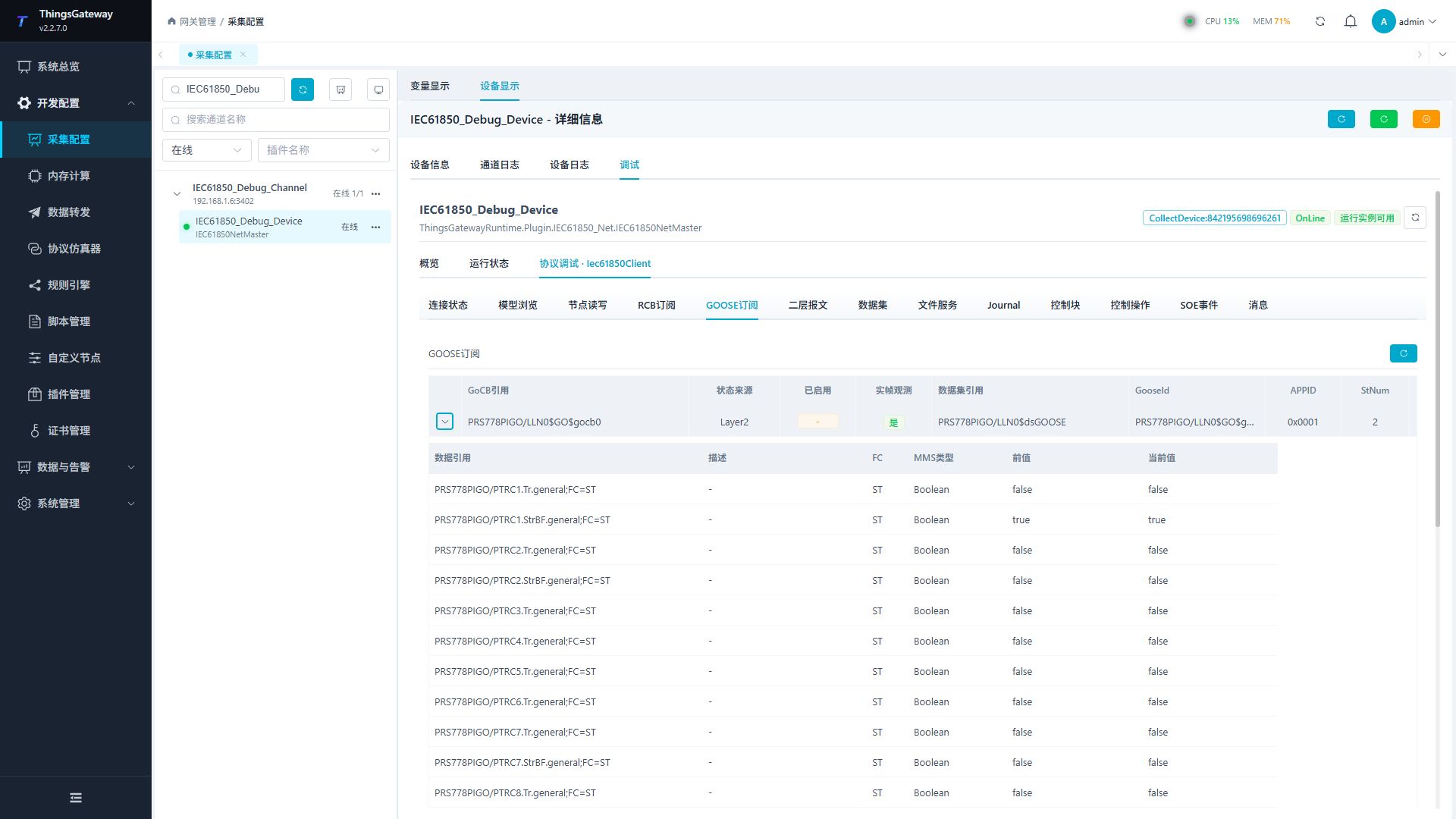
Opening GOOSE Subscriptions briefly listens on the physical interface routed to the current IED. A valid 0x88B8 frame remains visible even when the IED does not answer MMS GoCB directory requests. The row shows GoCB, DataSet, GooseId, APPID, StNum, SqNum, and value count.
Expand the row to compare data reference, description, FC, MMS type, previous value, and current value. References and FCs come from the GOOSE data-set directory. Descriptions are matched from Gateway variables on the current device; - means no description is configured.
Journal queries
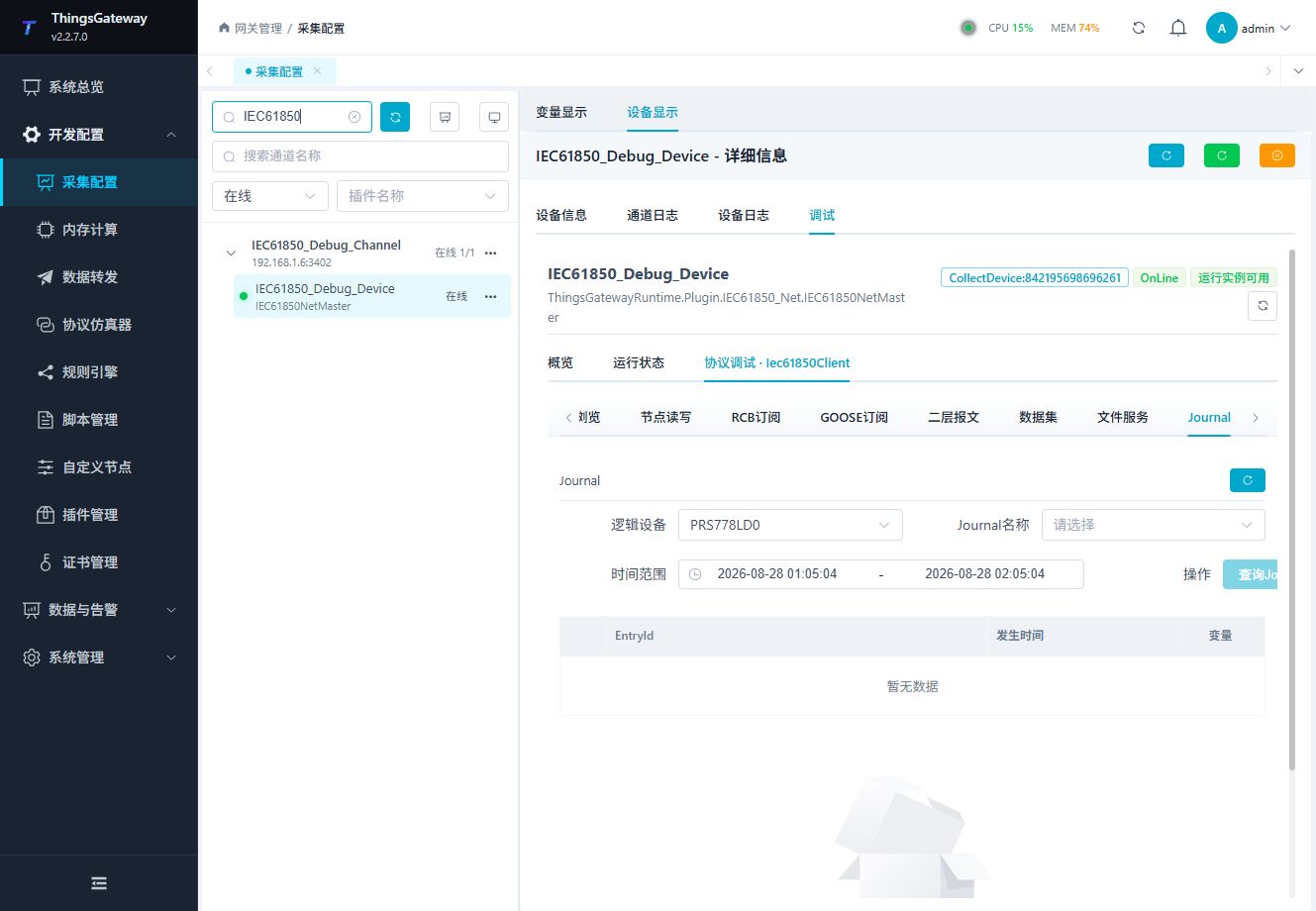
The Journal tab scans every logical device returned by the server and selects the first LD that actually exposes a Journal name. Choose a name and time range, then run Query Journal.
When all LDs successfully return empty directories, the page explicitly reports that no logical device returned a Journal name. This is a server-model condition, not a client parsing failure. You may enter a known Journal name manually when the server accepts direct reads but omits the directory entry.
Verification
- Confirm that Association State is
Connected. - Expand a responsive LD in Model Browser, copy a leaf reference, and read it under Node Read/Write.
- Under GOOSE Subscriptions, verify a
Layer2orMMS + Layer2row and inspect reference, FC, previous value, and current value. - Under Layer 2 Frames, select the receiving NIC and verify the GOOSE, SV, or R-Session counters and decoded fields.
- Check the Journal directory. Treat an all-empty result as a server that publishes no Journal.
- File mutations, data-set changes, control-block writes, and controls change IED state. Run them only on approved test objects.
Troubleshooting
| Symptom | Check |
|---|---|
| Association cannot be established | Remote address, port, network, firewall, ACSE password, channel TLS, and certificates. |
| Only some LDs fail to expand | Whether those domains answer paged GetNameList requests and whether dynamic control blocks are registered correctly. Do not treat successful LDs as offline. |
| GOOSE status is empty | Physical NIC, VLAN, multicast, APPID, Npcap/AF_PACKET permission, and cyclic publishing. |
| GOOSE values lack canonical references | Data-set existence and permission to read GetNamedVariableListAttributes. |
| Journal list is empty | Check every LD directory. An all-empty result means the server publishes no Journal. |
| File service fails | IED file-service support, file name, permission, and maximum file size. |
| Write or control fails | Object FC, control model, IED permission, variable protection mode, and site interlocks. |
Related links
- Collection Configuration: Common channel, device, variable, import, and debug entry points.
- Certificate Management: Client certificates and CAs used by TCP/TLS channels.
- IEC61850 Server: Publish MMS models and GOOSE from the Gateway.