CanMaster
Purpose
CAN and CAN FD frame transceiver, filtering and variable mapping driver
Open the plugin
Enter "Development Configuration → Collection Configuration", create a device and select "CanMaster" in "Collection Plugin".
Supported channels and data types
| Channel type | Pre-configuration check |
|---|---|
| Plugin built-in connection | Connection parameters are configured in the device dynamic properties and do not use public TCP, UDP or serial channel parameters. |
Optional data types: Boolean, Byte, Int16, UInt16, Int32, UInt32, Int64, UInt64, Float, Double, String, Decimal
Plugin properties
CAN Master opens the bus directly through CanKit; the channel is only used for the common device lifecycle and does not use ordinary TCP, UDP, or serial fields. Configure common timeout, data format, and string-reversal settings through the collection configuration; this page lists CAN-specific fields.
Connection configuration
| Setting | Description |
|---|---|
| Endpoint address | Default: virtual://alpha/0; fill in: text input. Sets the endpoint address used when establishing connections. |
Protocol parameters
| Setting | Description |
|---|---|
| Baud rate | Default: 500000; fill in: digital input. Set the baud rate used for protocol communication. |
| Data phase baud rate | Default: 2000000; fill in: digital input. Set the data phase baud rate used for protocol communication. |
| Protocol mode | Default: 1; fill in: drop-down selection. Set the protocol mode used for protocol communication. |
| Enable BRS | Default: No; fill in: switch. Controls whether the "Enable BRS" function is enabled. |
| Internal termination resistor | Default: Yes; fill in: switch. Controls whether the "internal termination resistor" function is enabled. |
| Hardware filter CANID list | Fill in: Integer list dialog box. Set the hardware filter CANID list used for protocol communication. |
Protocol mode options are Can20 (classic CAN) and CanFd (CAN FD). Classic CAN carries at most 8 data bytes; CAN FD carries at most 64. Data-phase bitrate and BRS apply only to CanFd. Enable the internal termination resistor only when the adapter hardware provides it and no external resistor already terminates the bus.
Address rules
- CAN address format: 0xCANID[.start byte][;R=0x response ID][;L=data length][;E=1(extended frame)]
- Example: 0x123, 0x123.2, 0x123;R=0x456;L=4;E=1
- Standard-frame CAN IDs are
0x000–0x7FF; setE=1for an extended frame, whose ID may be up to0x1FFFFFFF. - The
.start byteoffset is zero-based.Lis the read/write length:1–8in classic CAN and1–64in CAN FD; bytes beyond the frame are truncated. R=selects the response ID for request/response mode; without it the request ID is matched. An emptyFilterCanIdslist disables hardware filtering; a non-empty list accepts only those IDs.
Functions
| Function | Purpose |
|---|---|
| Read frame | Use Read frame to send or inspect protocol frames and view the device or target response. |
| Send frame | Use Send frame with an approved test point and confirm site safety before execution. |
| Debug result | View the returned value, success state, or error message. |
Device debug
Enter "Development Configuration → Collection Configuration", select the current device and click "More Functions", then open "Debug".
Dedicated debugging page
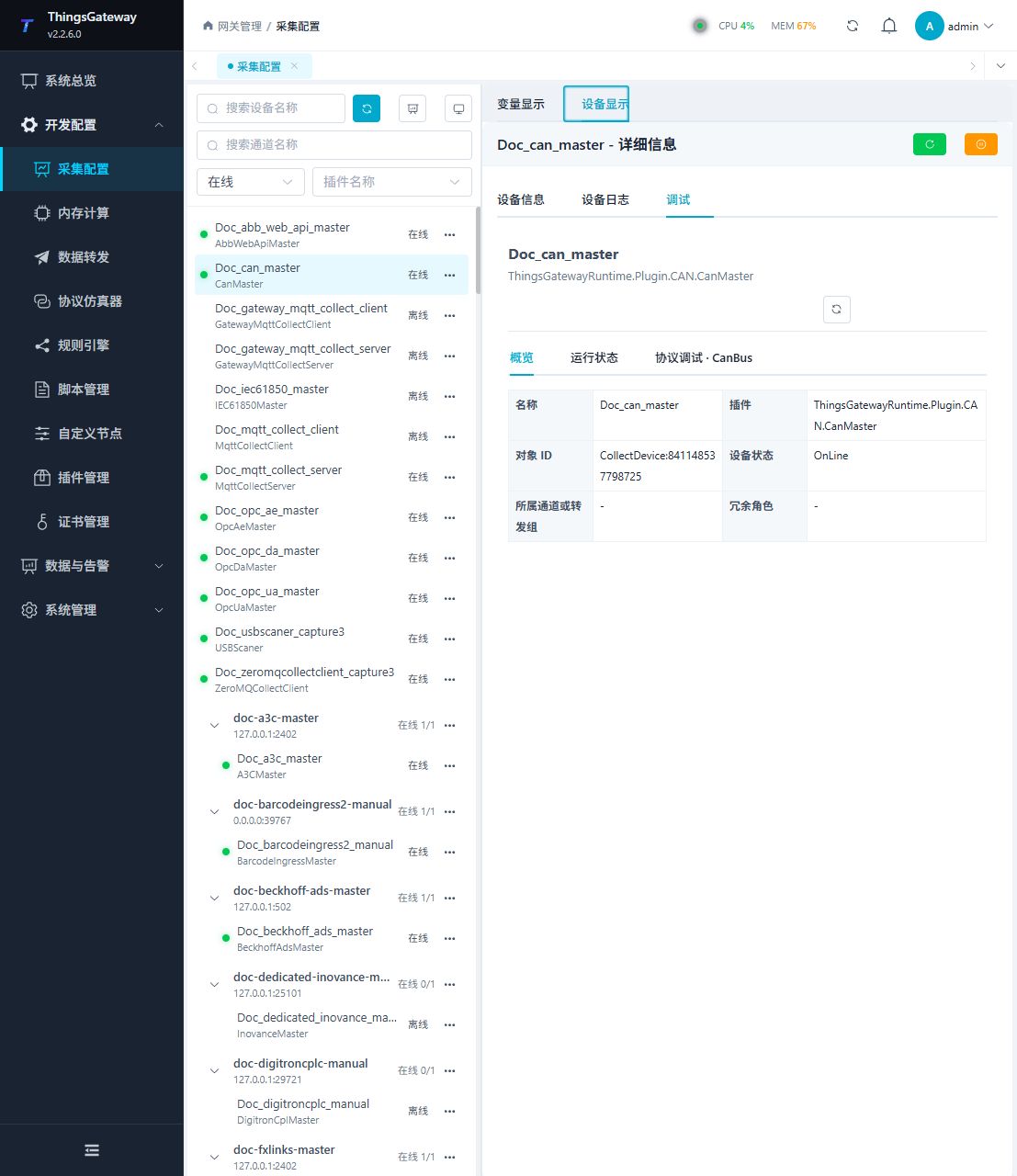
Open Development Configuration → Collection Configuration, select the device, and open More Functions → Debug. The following image shows the plugin-specific debug page.
Debugging notes
Send a test frame by CAN ID, Hexadecimal Data and Extended Frame options on the dedicated page; first verify the filter and response with a frame that does not affect the device.
Verify the configuration
- Use the plugin-specific debug panel with one confirmed test point or test message.
- Confirm that the returned value or received message matches the device point list.
- Perform writes or control operations only with an approved test point and the site safety procedure.
Troubleshooting
- The debug panel shows no result: Check the required inputs and plugin parameters, then inspect the device or target log for a response or error.
Related links
- Collection configuration: View channel, device and common variable configuration.
- Plugin Index: Find other collection or data-forward plugins.