Siemens S7
Purpose
The Siemens S7 plugin connects to Siemens S7 PLCs over TCP and reads or writes S7 areas.
Open the plugin
Open Development Configuration → Collection Configuration, create a device, and select Siemens S7.
Create the channel and device through Collection Configuration. This page covers S7-specific properties, address formats, special methods, and debug actions.
Supported channel and data types
| Channel type | Check before configuration |
|---|---|
| TCP client | Confirm the PLC IP address, port, and network reachability from the gateway. |
Supported data types: Boolean, Byte, Int16, UInt16, Int32, UInt32, Int64, UInt64, Float, Double, String, and Decimal.
Plugin properties
Siemens S7 supports only the TcpClient channel. Configure remote address, connection timeout, retry count, read/write duty cycle, write priority, data format, string byte reversal, and other common fields through Collection Configuration. The table below lists S7-specific settings and the S7 pack-size override.
| Setting | Default / description |
|---|---|
| PLC type | Default S200. Select the PLC family that matches the CPU. |
| Rack | Default 0. Rack number of the PLC CPU. |
| Slot | Default 0. Slot number of the PLC CPU module. |
| Local TSAP | Default 0. Local TSAP connection identifier. Set it to match the PLC connection resource when required. |
| Maximum pack size | Default 200. Maximum amount of data grouped into one read plan. Reduce it when the PLC or network has a smaller PDU limit. |
PLC type options are S200, S200Smart, S300, S400, S1200, and S1500. Rack, Slot, and Local TSAP are used when establishing the S7 session; restart or re-enable the device after changing them.
Address rules
Use the S7 area prefix followed by the byte address. Add .bit for a bit address.
| Format | Area / example |
|---|---|
Txxxxx | Timer, for example T100 or T100.1. |
Cxxxxx | Counter, for example C100 or C100.1. |
AIxxxxx | Analog input, for example AI100 or AI100.1. |
AQxxxxx | Analog output, for example AQ100 or AQ100.1. |
Ixxxxx | Input area, for example I100 or I100.1. |
Qxxxxx | Output area, for example Q100 or Q100.1. |
Mxxxxx | Marker area, for example M100 or M100.1. |
DB... | Data block, for example DB100.1 or DB100.1.1. |
Prefix a wide-string address with W=true;, for example W=true;DB1.0; without the prefix the normal string decoder is used. In a DB address, the first number is the DB block and the next number is the byte offset; a final .0–.7 is a bit index. Thus DB100.1 is byte 1 of DB100, while DB100.1.1 is bit 1 of that byte. V addresses are equivalent to DB1.
Confirm the area, byte offset, bit offset, data type, and array length with the PLC point list before importing variables.
Special methods
| Method | Use | Parameters |
|---|---|---|
ReadWriteDateAsync | Reads or writes an S7 date value. | address, optional value |
ReadWriteDateTimeAsync | Reads or writes an S7 date-time value. | address, optional value |
For a read, leave the value empty. For a write, use a safe address and a value approved by the site procedure.
Functions
| Function | Purpose |
|---|---|
| Read and write | Read a confirmed point and write only to an approved test point. |
| Messages | View sent and received frames, protocol fields, and error details. |
Device debug
Open Development Configuration → Collection Configuration, select the Siemens S7 device, and click More Functions, then open Debug.
Read and write
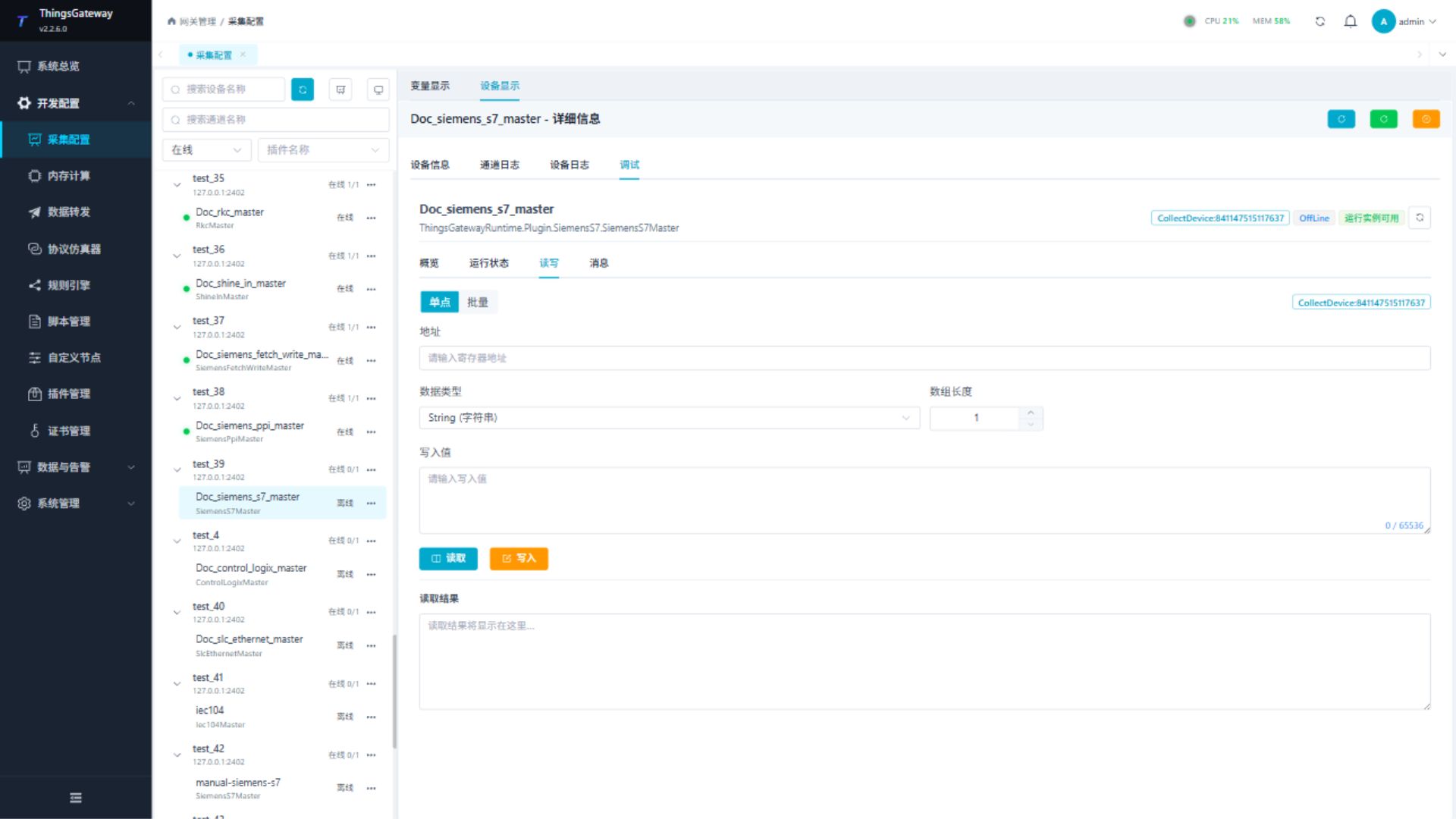
Read one confirmed address first. Before writing, check PLC state, address, data type, and field safety conditions.
Messages
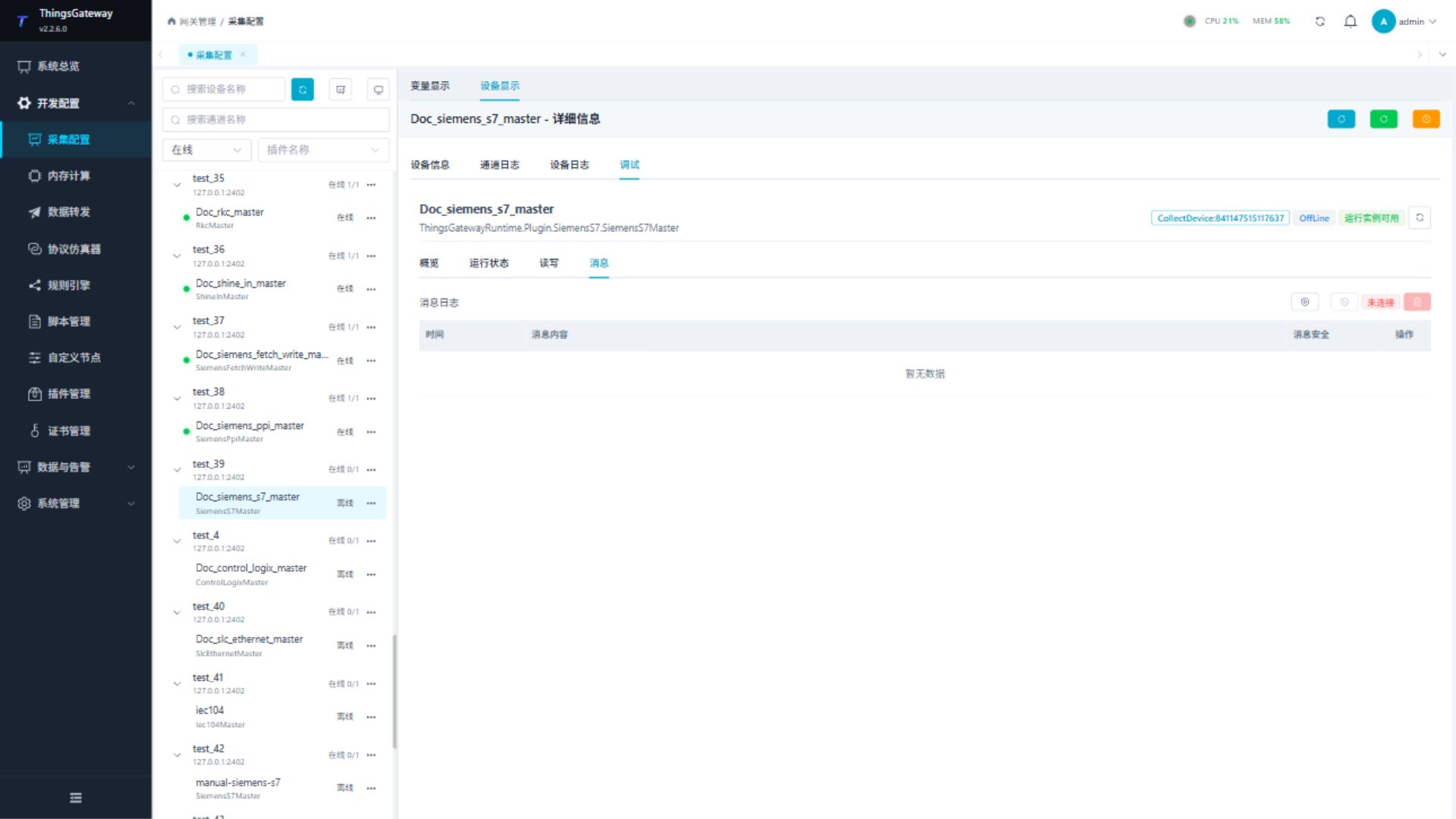
Use the message view to inspect connection, handshake, request, response, and parsing errors.
Verify the configuration
- Confirm the PLC type, rack, slot, and Local TSAP.
- Read one known input, marker, output, timer, counter, or DB address.
- Compare the value and data type with the PLC engineering tool.
- Test a special date method only on a safe point.
- Import the remaining point list after the single-point check passes.
Troubleshooting
| Symptom | Check |
|---|---|
| Cannot connect | PLC IP, port, firewall, PLC type, rack, slot, and Local TSAP. |
| Handshake fails | PLC family, rack/slot, Local TSAP, and the PLC connection resource configuration. |
| Address read fails | Area prefix, byte/bit offset, DB number, data type, and array length. |
| Value is incorrect | Data type, byte order, address offset, and the PLC engineering tool's display format. |
| Special method fails | Method name, address format, parameter value, write permission, and PLC operating state. |
| Wide string is garbled or truncated | Confirm W=true;, the variable data type, array length, and the PLC string layout. |
Related links
- Collection Configuration: Channels, devices, variables, import, and common debug entry.
- Plugin Manual Index: Other collection and data-forwarding plugins.