KeyenceKvOldMaster
Purpose
KEYENCE old KV PLC address read and write driver
Open the plugin
Enter "Development Configuration → Collection Configuration", create a device and select "KeyenceKvOldMaster" in "Collection Plugin".
Supported channels and data types
| Channel type | Pre-configuration check |
|---|---|
| TCP Client | Confirm network reachability of the device IP, port, and gateway to the device. |
Optional data types: Boolean, Int16, UInt16
Address rules
- Keyence old KV contact address: R must use word number.bit number, such as R10.3; T, C, CTH and CTC are also supported.
- WORD addresses: DM, TM, AT, CTH, CC, CS, TC and TS; each RD, WR or WS command accesses only one sixteen-bit value at a time.
- The request ends with CR, and the response must end with CRLF; CR is executed for each TCP connection, and CQ is executed before normal disconnection; the commonly used port is 8501.
Functions
| Function | Purpose |
|---|---|
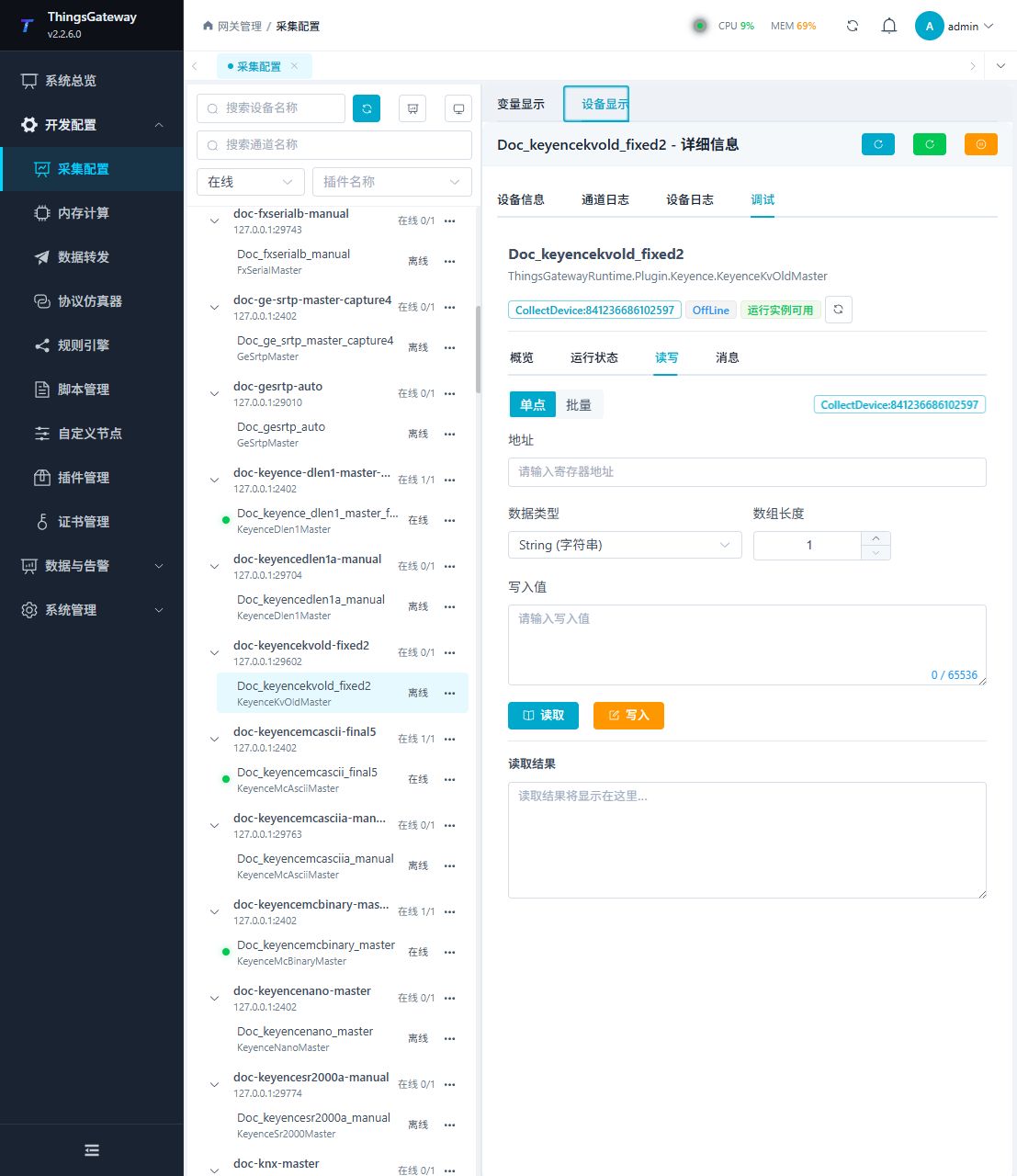
| Read and write | Read a confirmed point and write only to an approved test point. |
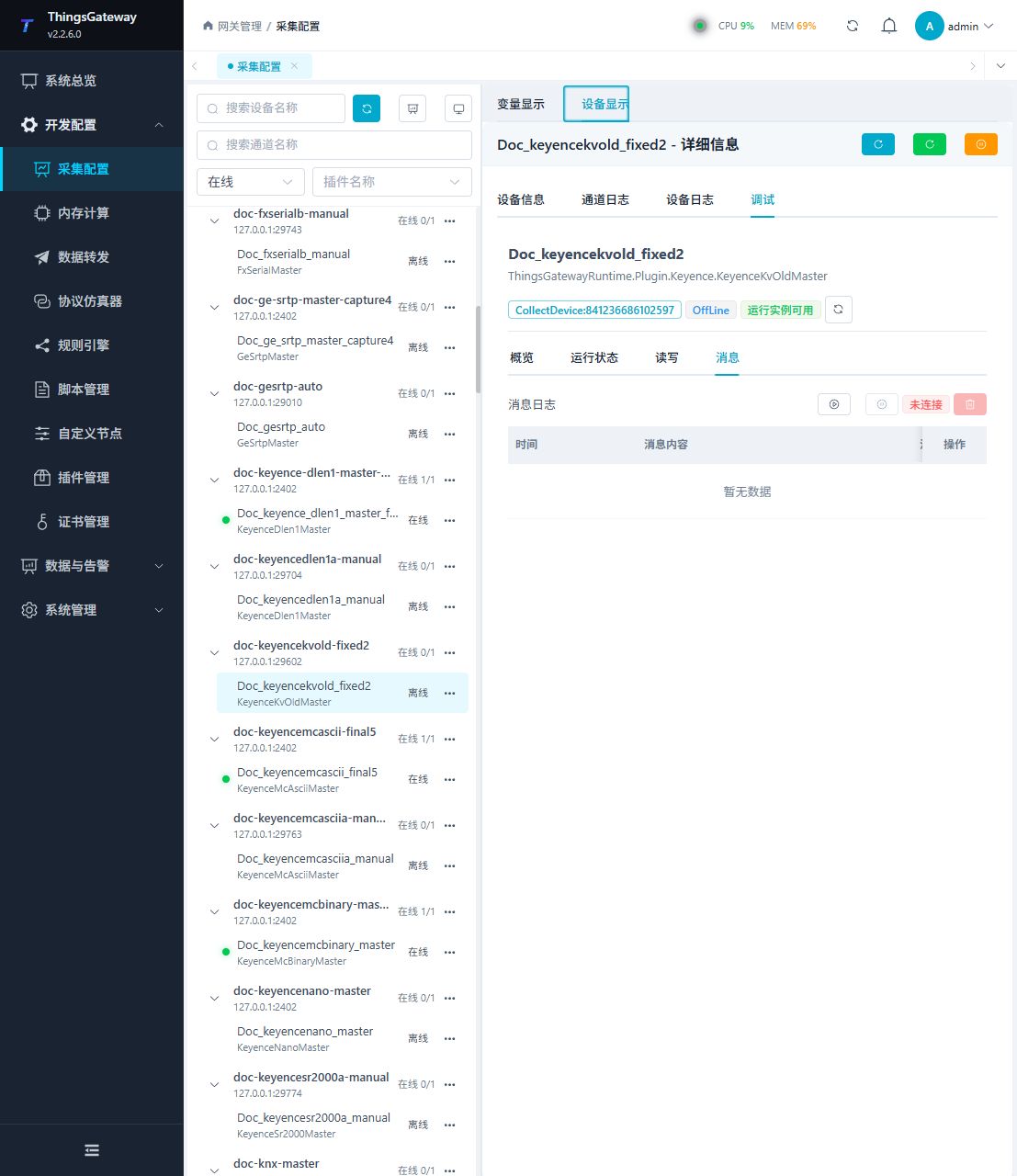
| Messages | View sent and received frames, protocol fields, and error details. |
Device debug
Enter "Development Configuration → Collection Configuration", select the current device and click "More Functions", then open "Debug".
Dedicated debugging page
Open Development Configuration → Collection Configuration, select the device, and open More Functions → Debug. The following image shows the plugin-specific debug page.
Debugging notes
First read the PLC type, mode and expansion unit; clear the CPU error, set the time and write the expansion unit before confirming twice.
Verify the configuration
Use a confirmed on-site address to perform reading. The return value, data type and byte order should be consistent with the point list; after the writable point is written, it should be read back according to on-site requirements.
Troubleshooting
- Address reading failed: Check the station number, register or node ID one by one according to the address rules on this page, and confirm that the data type is consistent with the device point list.
Related links
- Collection configuration: View channel, device and common variable configuration.
- Plugin Index: Find other collection or data-forward plugins.