OmronHostLinkCModeMaster
Purpose
Omron Host Link C-Mode address reading and writing and PLC status diagnostic driver
Open the plugin
Enter "Development Configuration → Collection Configuration", create a device and select "OmronHostLinkCModeMaster" in "Collection Plugin".
Supported channels and data types
| Channel type | Pre-configuration check |
|---|---|
| Serial Port | Confirm that the serial port is not occupied by other programs and maintains the same baud rate, data bits, stop bits and parity bits as the device. |
| TCP Client | Confirm network reachability of the device IP, port, and gateway to the device. |
| TCP server | Confirm that the local listening address and port are available, and allow on-site devices to actively connect to the gateway. |
Optional data types: Boolean, Int16, UInt16, Int32, UInt32, Float, String
Plugin properties
Protocol parameters
| Setting | Description |
|---|---|
| PLC station number | Default: 0; fill in: text input. Set the default station number used when the station number is not specified separately in the variable address. |
Address rules
- HostLink C-mode WORD address: D/DM, C/CIO, LR, H/HR, A/AR, TIM, CNT, E hexadecimal area code. Address, such as D100, CNT20, E1.100.
- TIM/CNT Boolean variable reading completion status; C-mode does not support ordinary bit area writing.
- The address can use s=2;D100 to overwrite the default station number; the station number ranges from 0 to 255.
- Reads are automatically split by up to 30 points, WORD writes are automatically split by up to 30 WORDs; TCP variants use the same wire frame.
Special methods
| Method | Purpose | Parameters |
|---|---|---|
| ReadPlcTypeAsync | Read PLC model | No parameters |
| ReadPlcModeAsync | Read PLC mode | No parameters |
Functions
| Function | Purpose |
|---|---|
| Read PLC model | Use Read PLC model to inspect mapped values, status, counters, recent messages, or the latest result. |
| Read PLC mode | Use Read PLC mode to inspect mapped values, status, counters, recent messages, or the latest result. |
Device debug
Enter "Development Configuration → Collection Configuration", select the current device and click "More Functions", then open "Debug".
Dedicated debugging page
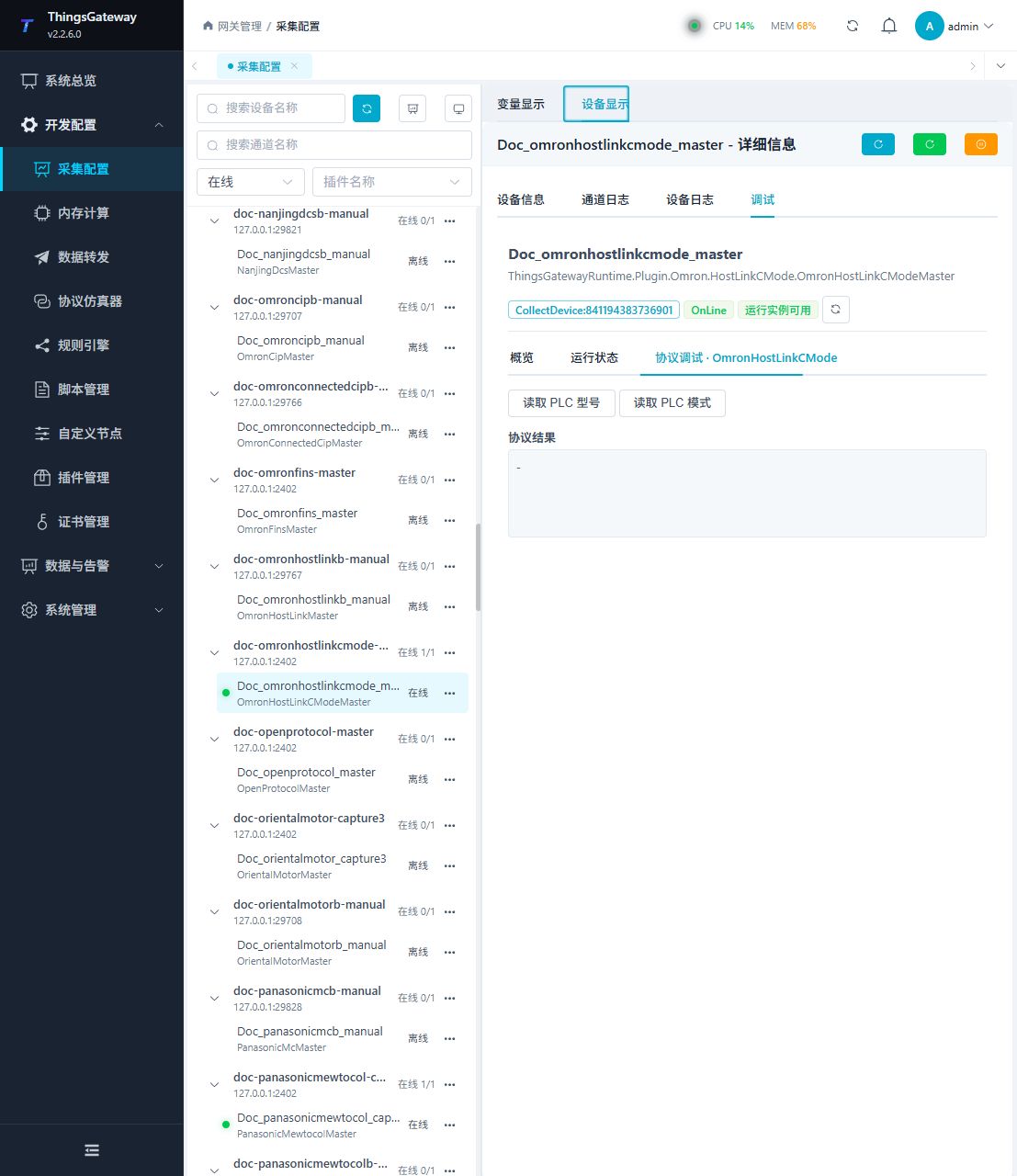
Open Development Configuration → Collection Configuration, select the device, and open More Functions → Debug. The following image shows the plugin-specific debug page.
Debugging notes
The dedicated page verification can be completed by reading the PLC type and mode. The current page only provides query operations.
Verify the configuration
- Use the plugin-specific debug panel with one confirmed test point or test message.
- Confirm that the returned value or received message matches the device point list.
- Perform writes or control operations only with an approved test point and the site safety procedure.
Troubleshooting
- The debug panel shows no result: Check the required inputs and plugin parameters, then inspect the device or target log for a response or error.
- Special method execution fails: Check method parameters and permissions; control, write or reset methods also need to confirm that the device is in a state that allows operation.
- The serial port device does not respond: Confirm that the serial port is not occupied, and check the baud rate, data bits, stop bits and parity bits.
Related links
- Collection configuration: View channel, device and common variable configuration.
- Plugin Index: Find other collection or data-forward plugins.