Mc1E_AsciiMaster
Purpose
Mitsubishi MC 1E ASCII protocol PLC address read and write driver
Open the plugin
Enter "Development Configuration → Collection Configuration", create a device and select "Mc1E_AsciiMaster" in "Collection Plugin".
Supported channels and data types
| Channel type | Pre-configuration check |
|---|---|
| Serial Port | Confirm that the serial port is not occupied by other programs and maintains the same baud rate, data bits, stop bits and parity bits as the device. |
| TCP Client | Confirm network reachability of the device IP, port, and gateway to the device. |
| TCP server | Confirm that the local listening address and port are available, and allow on-site devices to actively connect to the gateway. |
| UDP | Confirm the local binding address, port and firewall rules, and check the source of the packet. |
Optional data types: Boolean, Byte, Int16, UInt16, Int32, UInt32, Int64, UInt64, Float, Double, String, Decimal
Plugin properties
Protocol parameters
| Setting | Description |
|---|---|
| PLCID | Default: 255; fill in: text input. Set the PLCID used for protocol communication. |
Address rules
- MC 1E ASCII bit device: B, CC, CS, F, M, S, TC, TS, X, Y.
- MC 1E ASCII WORD device: CN, D, R, TN, W.
- B and W addresses are parsed in hexadecimal; when the digital part of X and Y starts with 0, they are parsed in octal, otherwise they are parsed in hexadecimal; other device addresses are parsed in decimal.
- WORD can access individual bits using "address.bitoffset" with a bit offset in the range 0 to 15.
- Example: M100, D100, D100.3, B10, W10, X010, Y10.
Functions
| Function | Purpose |
|---|---|
| Read and write | Read a confirmed point and write only to an approved test point. |
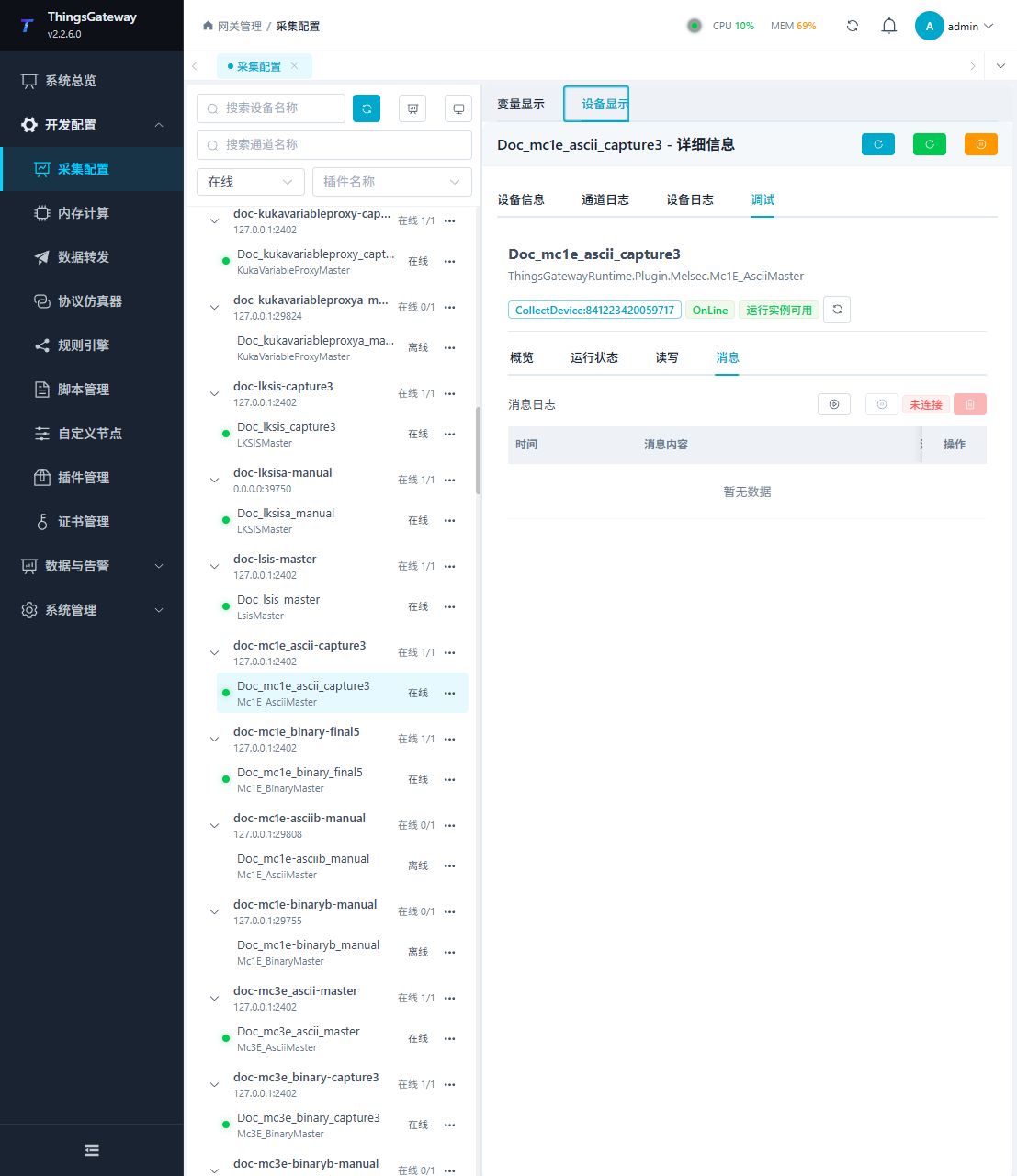
| Messages | View sent and received frames, protocol fields, and error details. |
Device debug
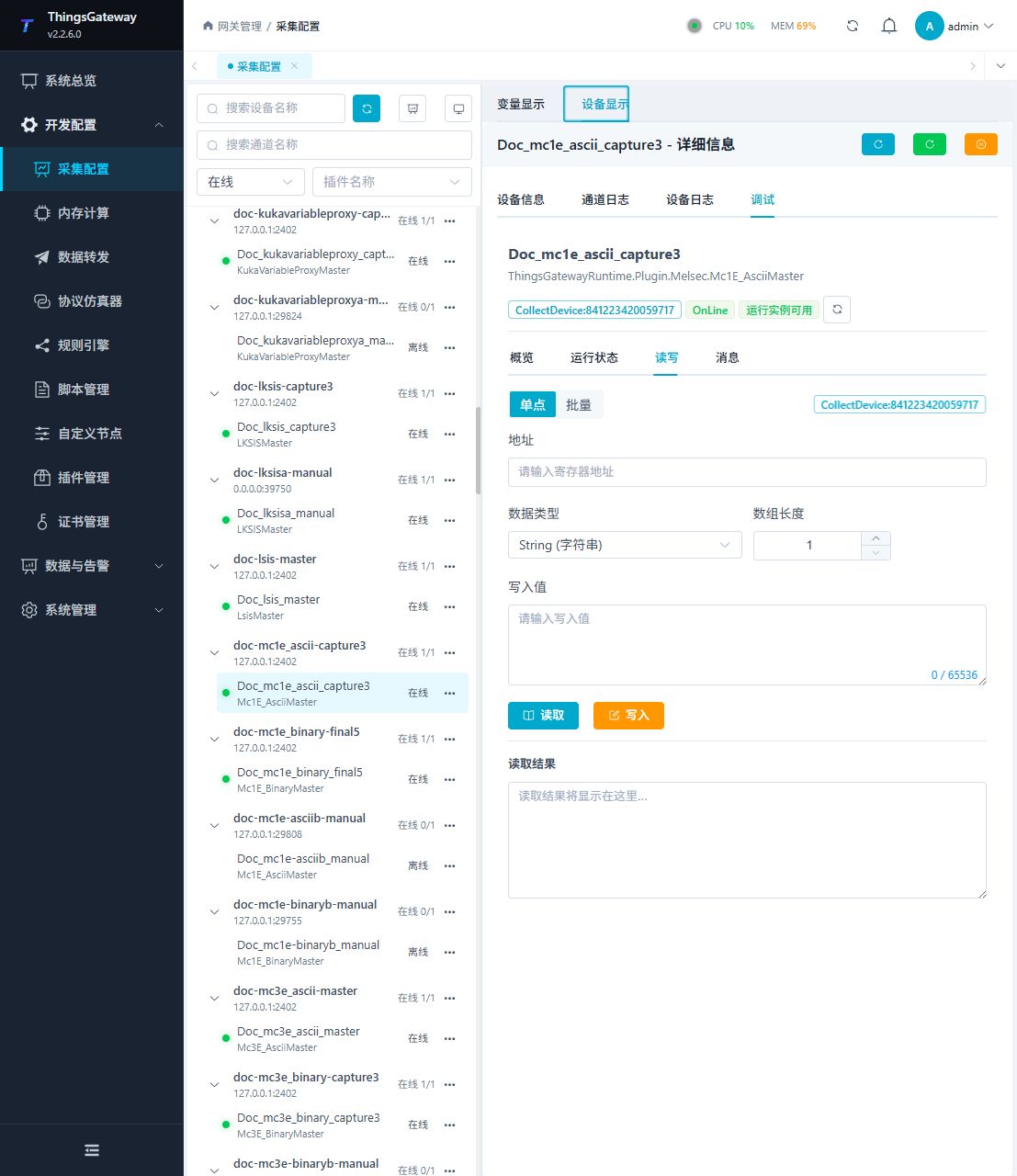
Enter "Development Configuration → Collection Configuration", select the current device and click "More Functions", then open "Debug".
Dedicated debugging page
Open Development Configuration → Collection Configuration, select the device, and open More Functions → Debug. The following image shows the plugin-specific debug page.
Verify the configuration
Use a confirmed on-site address to perform reading. The return value, data type and byte order should be consistent with the point list; after the writable point is written, it should be read back according to on-site requirements.
Troubleshooting
- Address reading failed: Check the station number, register or node ID one by one according to the address rules on this page, and confirm that the data type is consistent with the device point list.
- The serial port device does not respond: Confirm that the serial port is not occupied, and check the baud rate, data bits, stop bits and parity bits.
Related links
- Collection configuration: View channel, device and common variable configuration.
- Plugin Index: Find other collection or data-forward plugins.