SiemensFetchWriteMaster
Purpose
Siemens Fetch/Write protocol PLC address read and write driver
Open the plugin
Enter "Development Configuration → Collection Configuration", create a device and select "SiemensFetchWriteMaster" in "Collection Plugin".
Supported channels and data types
| Channel type | Pre-configuration check |
|---|---|
| TCP Client | Confirm network reachability of the device IP, port, and gateway to the device. |
Optional data types: Boolean, Byte, Int16, UInt16, Int32, UInt32, Int64, UInt64, Float, Double, String
This plugin supports only the TcpClient channel. The defaults are ABCD data order and a 200-byte maximum pack size; configure common timeout, retry, and write-priority fields through Collection Configuration.
Address rules
- Fetch/Write addresses support I, Q, M, DB, T, and C, with decimal byte offsets; for example,
DB20.100. Boolean must explicitly use byte.bit, such asM100.3, and is implemented through byte read-modify-write. The I area is read-only, DB/T/C access lengths must be even, and the current version supports TCP clients only.
Functions
| Function | Purpose |
|---|---|
| Read and write | Read a confirmed point and write only to an approved test point. |
| Messages | View sent and received frames, protocol fields, and error details. |
Device debug
Enter "Development Configuration → Collection Configuration", select the current device and click "More Functions", then open "Debug".
Read and write
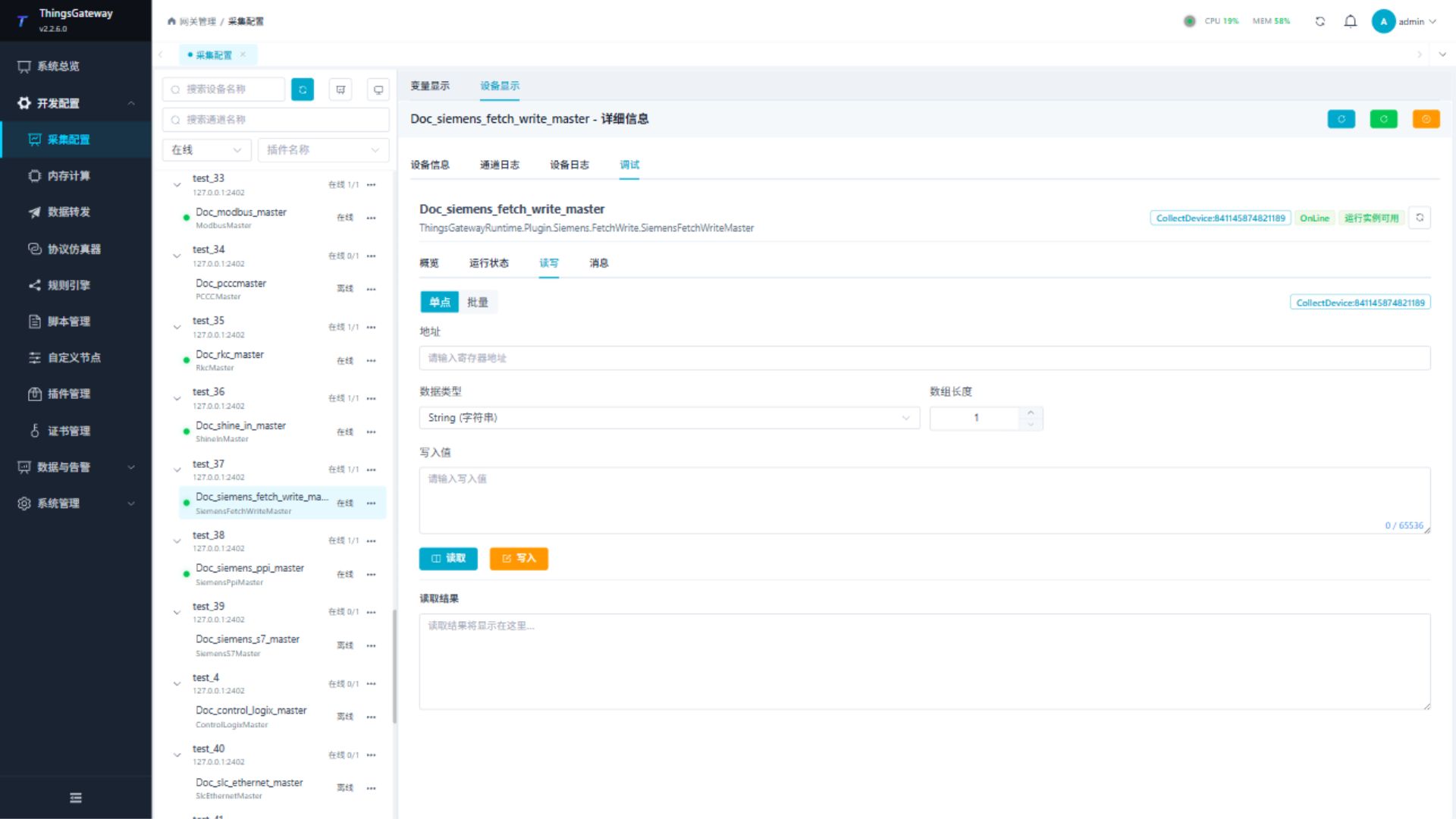
Perform read or write verification according to the current plugin address rules; confirm on-site security and permissions before writing.
Messages
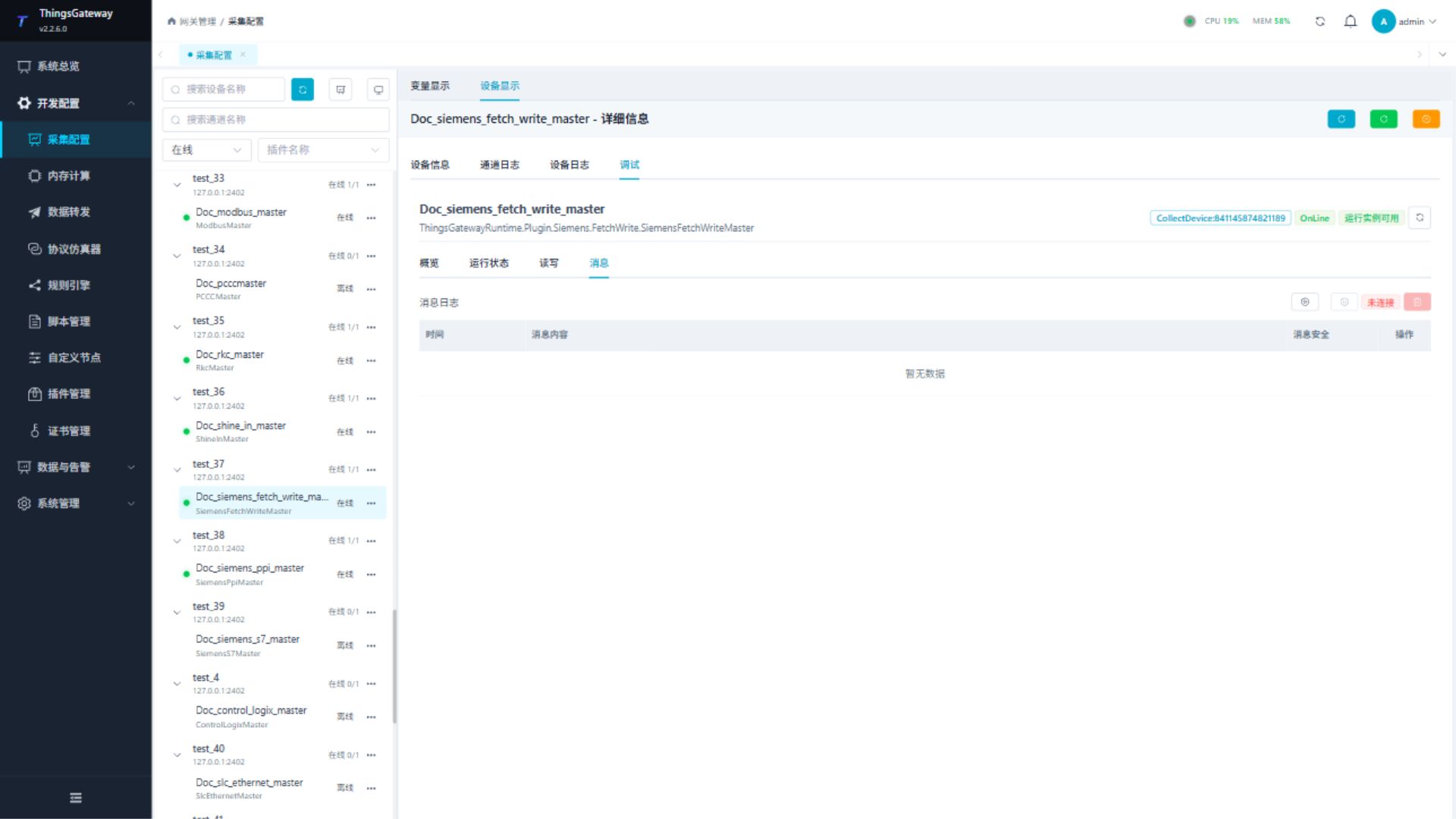
Check the device's message sending and receiving and protocol logs to locate message format, connection and parsing problems.
Verify the configuration
Use a confirmed on-site address to perform reading. The return value, data type and byte order should be consistent with the point list; after the writable point is written, it should be read back according to on-site requirements.
Troubleshooting
- Address reading failed: Check the station number, register or node ID one by one according to the address rules on this page, and confirm that the data type is consistent with the device point list.
Related links
- Collection configuration: View channel, device and common variable configuration.
- Plugin Index: Find other collection or data-forward plugins.