On this page
Mitsubishi A3C serial master
Mitsubishi A3C serial protocol address read and write, status and control driver
Open the plugin
Enter “Development Configuration → Collection Configuration”, create a device and select “A3CMaster” in “Collection Plugin”.
Supported channels and data types
| Channel type | Pre-configuration check |
|---|---|
| Serial Port | Confirm that the serial port is not occupied by other programs and maintains the same baud rate, data bits, stop bits and parity bits as the device. |
| TCP Client | Confirm network reachability of the device IP, port, and gateway to the device. |
| TCP server | Confirm that the local listening address and port are available, and allow on-site devices to actively connect to the gateway. |
Optional data types: Boolean, Byte, Int16, UInt16, Int32, UInt32, Int64, UInt64, Float, Double, String, Decimal
This list describes types allowed by the plugin editor. Address width, arrays, string length and read/write restrictions still follow this page; it does not mean that every address supports every type.
Plugin properties
Protocol parameters
| Setting | Description |
|---|---|
| Default station number | Default: 0; fill in: text input. Set the default station number used when the station number is not specified separately in the variable address. |
| Enable and verify | Default: Yes; fill in: switch. Controls whether the “Enable and Verify” feature is enabled. |
Data format
| Setting | Description |
|---|---|
| A3C frame format | Default: 1; fill in: drop-down selection. Set the A3C frame format used for data parsing or serialization. |
Address rules
- A3C bit device area: X, Y, M, S, L, F, V, B, SM, SB, DX, DY, TS, TC, SS, SC, CS, CC.
- A3C WORD device area: D, SD, W, SW, R, Z, ZR, TN, SN, CN.
- The default station number can be overridden for a single address using s=2;D100; WORD area Boolean access must explicitly specify a .0 to .15 bit number.
Special methods
| Method | Purpose | Parameters |
|---|---|---|
| RemoteRunAsync | Run PLC | No parameters |
| RemoteStopAsync | Stop PLC | No parameters |
| ReadPlcTypeAsync | Read PLC model | No parameters |
Device debug
Enter “Development Configuration → Collection Configuration”, select the current device then open “Protocol Debug” at the top of the workspace.
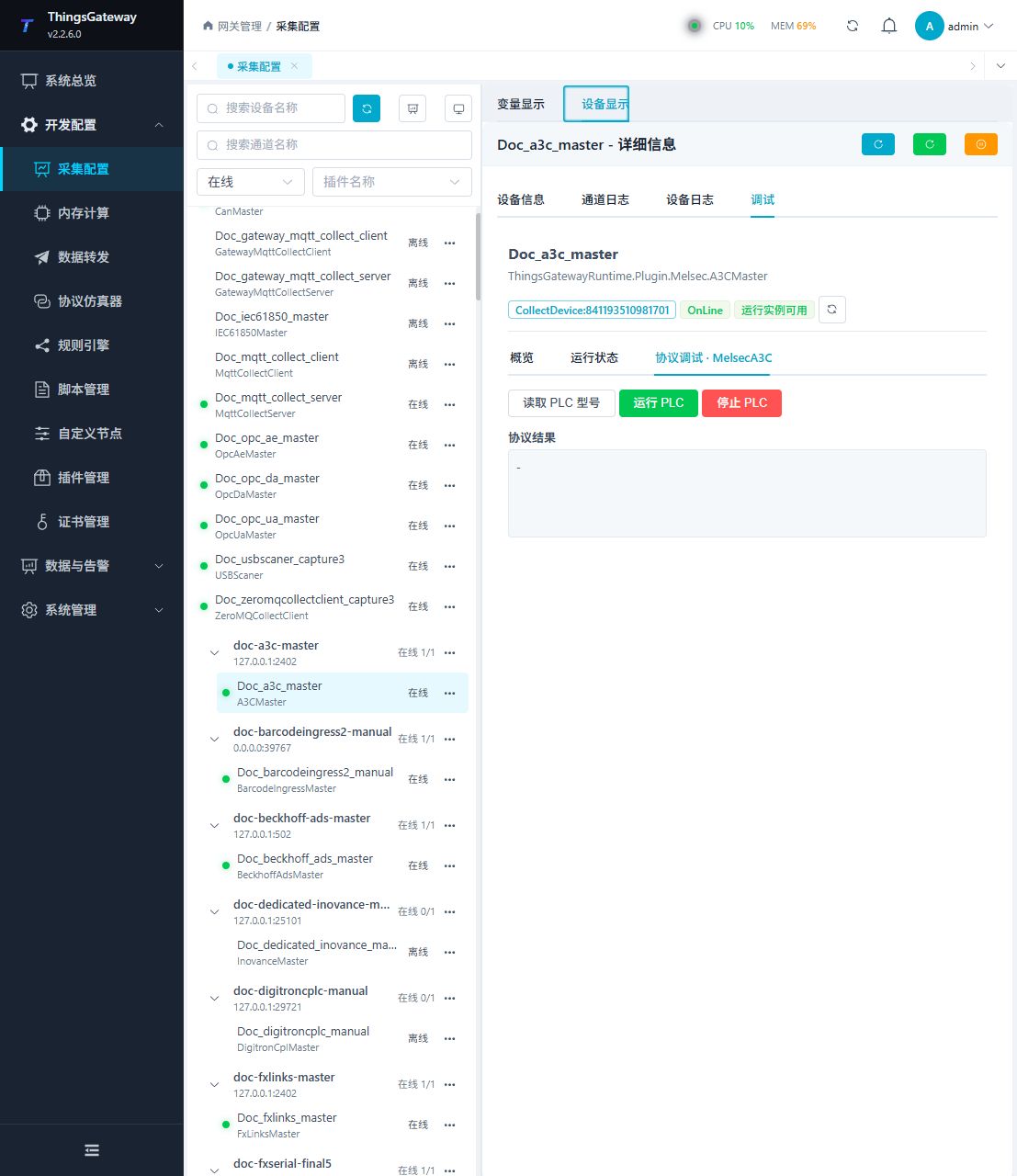
Debugging notes
Read the PLC type first; remote running and stopping are high-risk controls and must be confirmed twice before execution.
Functions
| Function | Purpose |
|---|---|
| Read PLC model | Use Read PLC model to inspect mapped values, status, counters, recent messages, or the latest result. |
| Remote run | Use Remote run with an approved test point and confirm site safety before execution. |
| Remote stop | Use Remote stop with an approved test point and confirm site safety before execution. |
Verify the configuration
Monitor D100 online in the PLC engineering tool, compare its value with the gateway variable and confirm advancing sample times.
Writes and control operations require an approved test point and the site safety procedure.
Troubleshooting
- WORD Boolean addresses require
.0–.15. For framing or checksum failures, test one WORD at the same station first. - Special method execution fails: Check method parameters and permissions; control, write or reset methods also need to confirm that the device is in a state that allows operation.
- The serial port device does not respond: Confirm that the serial port is not occupied, and check the baud rate, data bits, stop bits and parity bits.
Related links
- Collection configuration: View channel, device and common variable configuration.
- Plugin Index: Find other collection or data-forward plugins.