On this page
KEYENCE KV Host Link
KEYENCE old KV PLC address read and write driver
Open the plugin
Enter “Development Configuration → Collection Configuration”, create a device and select “KeyenceKvOldMaster” in “Collection Plugin”.
Supported channels and data types
| Channel type | Pre-configuration check |
|---|---|
| TCP Client | Confirm network reachability of the device IP, port, and gateway to the device. |
Optional data types: Boolean, Int16, UInt16
This list describes types allowed by the plugin editor. Address width, arrays, string length and read/write restrictions still follow this page; it does not mean that every address supports every type.
Address rules
- Keyence old KV contact address: R must use word number.bit number, such as R10.3; T, C, CTH and CTC are also supported.
- WORD addresses: DM, TM, AT, CTH, CC, CS, TC and TS; each RD, WR or WS command accesses only one sixteen-bit value at a time.
- The request ends with CR, and the response must end with CRLF; CR is executed for each TCP connection, and CQ is executed before normal disconnection; the commonly used port is 8501.
Device debug
Enter “Development Configuration → Collection Configuration”, select the current device then open “Protocol Debug” at the top of the workspace.
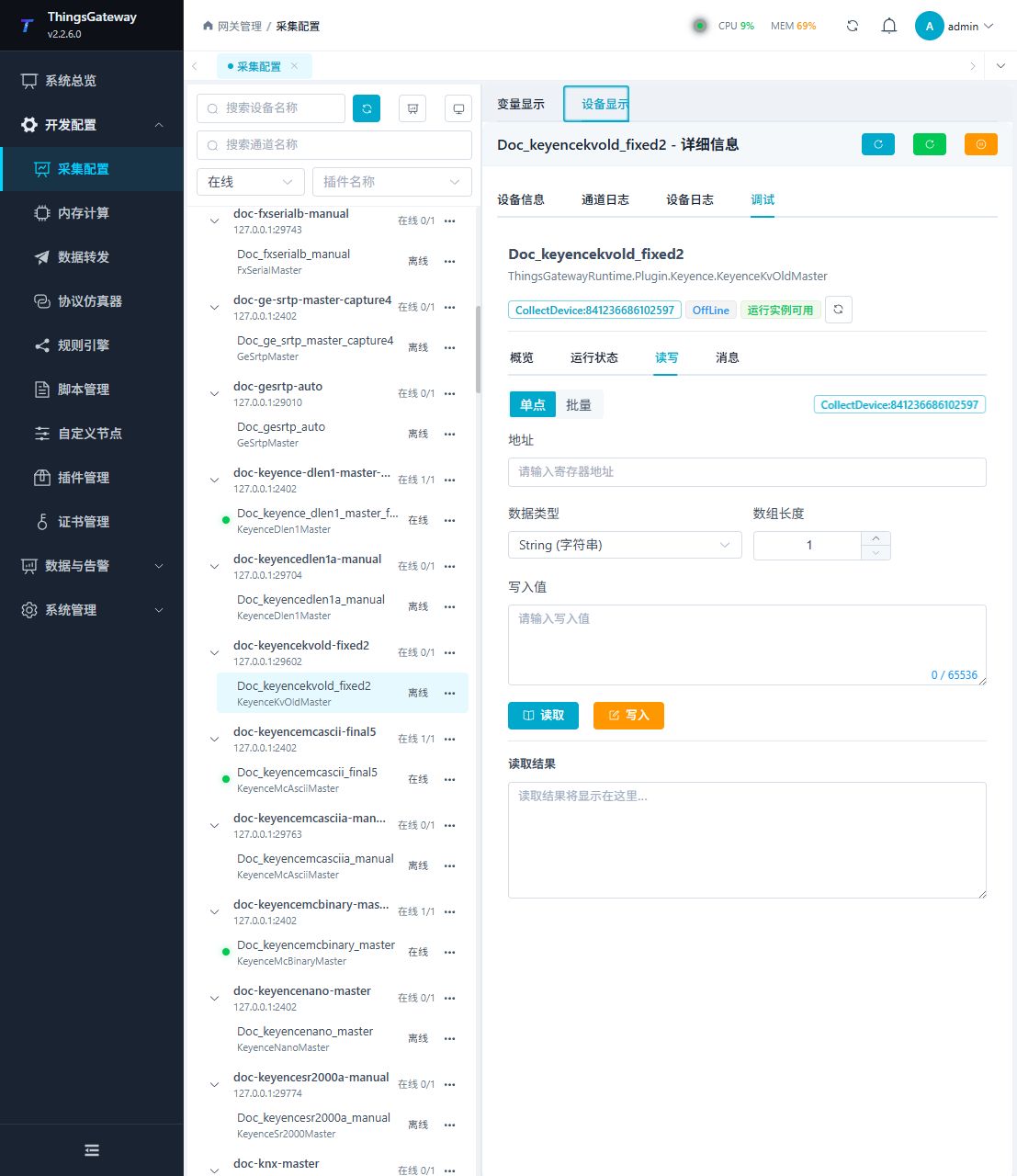
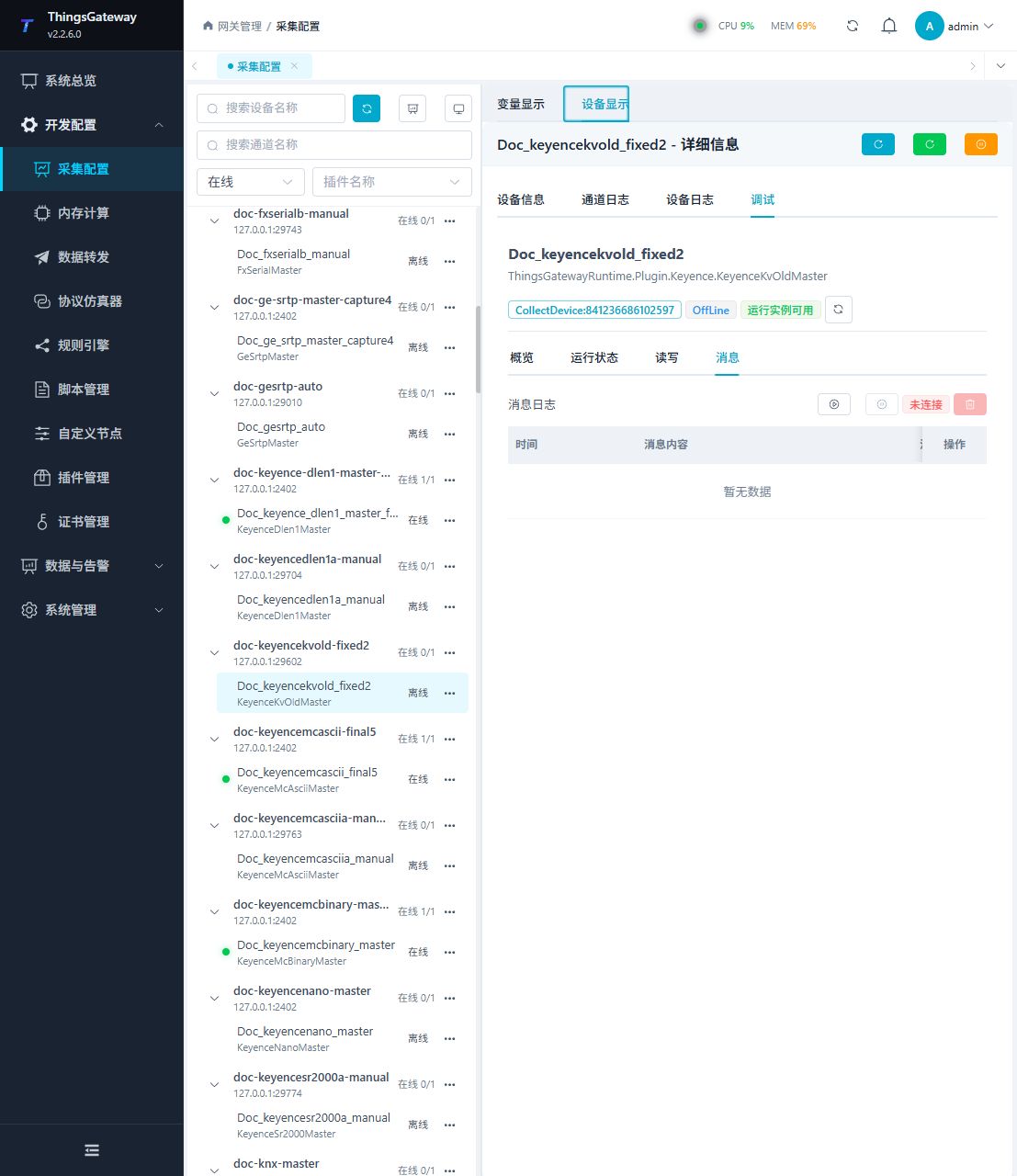
Debugging notes
First read the PLC type, mode and expansion unit; clear the CPU error, set the time and write the expansion unit before confirming twice.
Functions
| Function | Purpose |
|---|---|
| Read and write | Read a confirmed point and write only to an approved test point. |
| Messages | View sent and received frames, protocol fields, and error details. |
Verify the configuration
Monitor DM100 online in the PLC engineering tool, compare its value with the gateway variable and confirm advancing sample times.
Troubleshooting
- Complete the CR handshake. R bits use forms such as R10.3; supported types are Boolean, Int16 and UInt16.
Related links
- Collection configuration: View channel, device and common variable configuration.
- Plugin Index: Find other collection or data-forward plugins.