On this page
LS ELECTRIC Cnet / Fast Ethernet master
LSIS Cnet and Fast Ethernet PLC address read and write driver
Open the plugin
Enter “Development Configuration → Collection Configuration”, create a device and select “LsisMaster” in “Collection Plugin”.
Supported channels and data types
| Channel type | Pre-configuration check |
|---|---|
| Serial Port | Confirm that the serial port is not occupied by other programs and maintains the same baud rate, data bits, stop bits and parity bits as the device. |
| TCP Client | Confirm network reachability of the device IP, port, and gateway to the device. |
| TCP server | Confirm that the local listening address and port are available, and allow on-site devices to actively connect to the gateway. |
Optional data types: Boolean, Byte, Int16, UInt16, Int32, UInt32, Int64, UInt64, Float, Double, String
This list describes types allowed by the plugin editor. Address width, arrays, string length and read/write restrictions still follow this page; it does not mean that every address supports every type.
Plugin properties
Protocol parameters
| Setting | Description |
|---|---|
| Line protocol | Default: 0; fill in: drop-down selection. wire protocol; Cnet supports serial port, TCP client and TCP server sessions; Fast Ethernet only supports TCP client |
| Cnet station number | Default: 5; fill in: text input. Cnet station number; range is 00H to 1FH, default 05H |
| CPU series | Default: 160; fill in: drop-down selection. CPU family; target CPU family code to write Fast Ethernet request header |
| Module base number | Default: 0; fill in: text input. Module base number; the base where the Fast Ethernet communication module is located, ranging from 0 to 15 |
| Module slot number | Default: 3; fill in: text input. Module slot number; the slot where the Fast Ethernet communication module is located, ranging from 0 to 15 |
| Company logo | Default: LSIS-XGT; fill in: text input. Company logo; eight printable ASCII characters used in Fast Ethernet frame headers |
Address rules
- LSIS PLC equipment area: P, M, L, K, F, T, C, D, S, Q, I, N, U, Z, R.
- Boolean must use an explicit X-bit address, such as MX103 or MX10.3, with the last bit interpreted as hexadecimal 0 to F.
- Non-Boolean addresses use B, W, D, L widths, such as MB100, DW100, DD100, DL100; when the width is omitted, it is interpreted as a WORD address, for example, D100 is equivalent to DW100.
- Non-Boolean U-area topological addresses accept Uhex.decimal or Udecimal.decimal.decimal, and I/Q-area topological addresses accept three decimal components; topological bit addresses are not currently supported.
- Cnet supports serial port, TCP client and TCP server sessions; Fast Ethernet only supports TCP client, and the commonly used port is 2004.
- The CPU direct connection dedicated serial port reference behavior does not form a trusted complete write contract, and the current version does not replace Cnet with this mode.
Device debug
Enter “Development Configuration → Collection Configuration”, select the current device then open “Protocol Debug” at the top of the workspace.
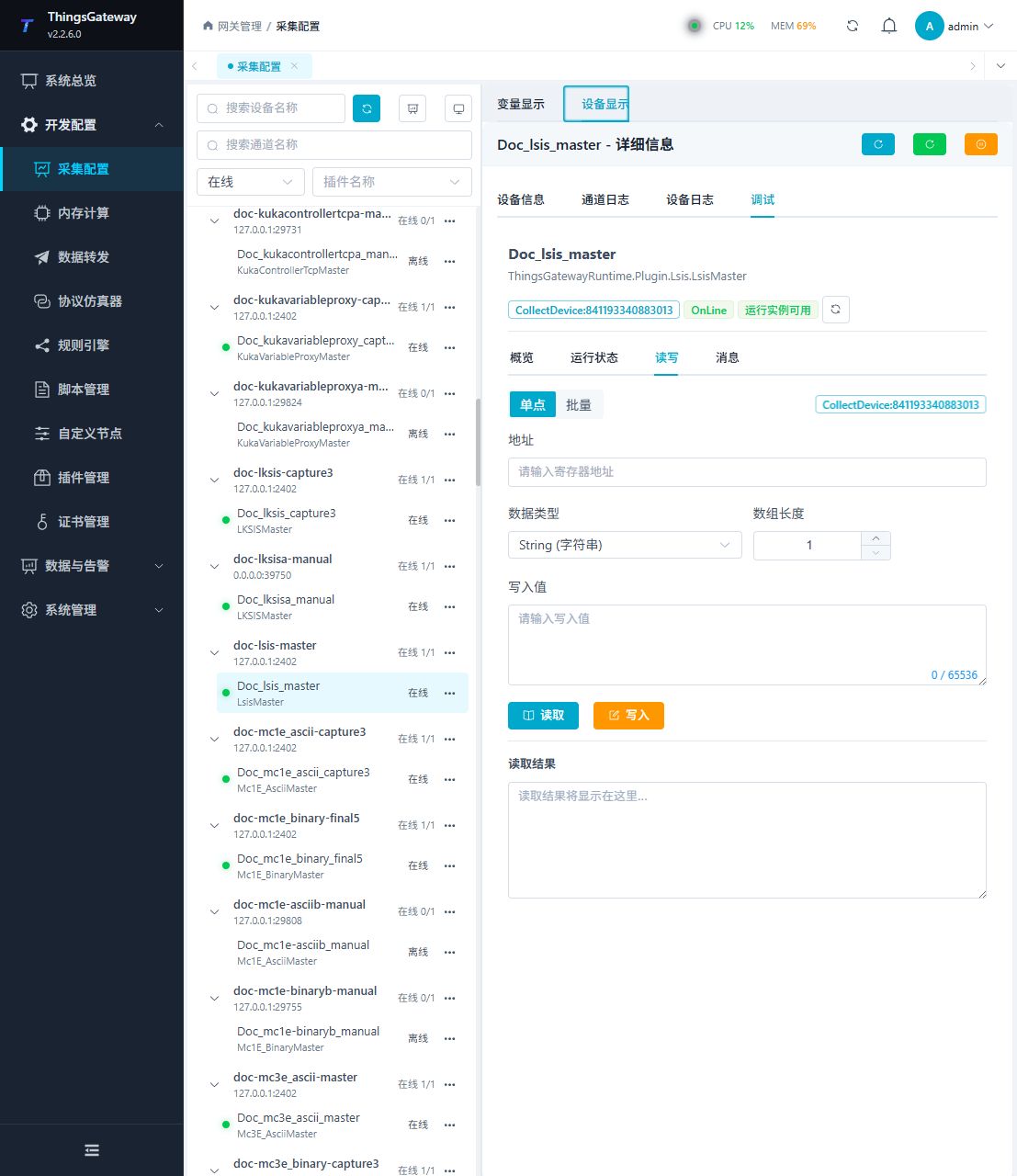
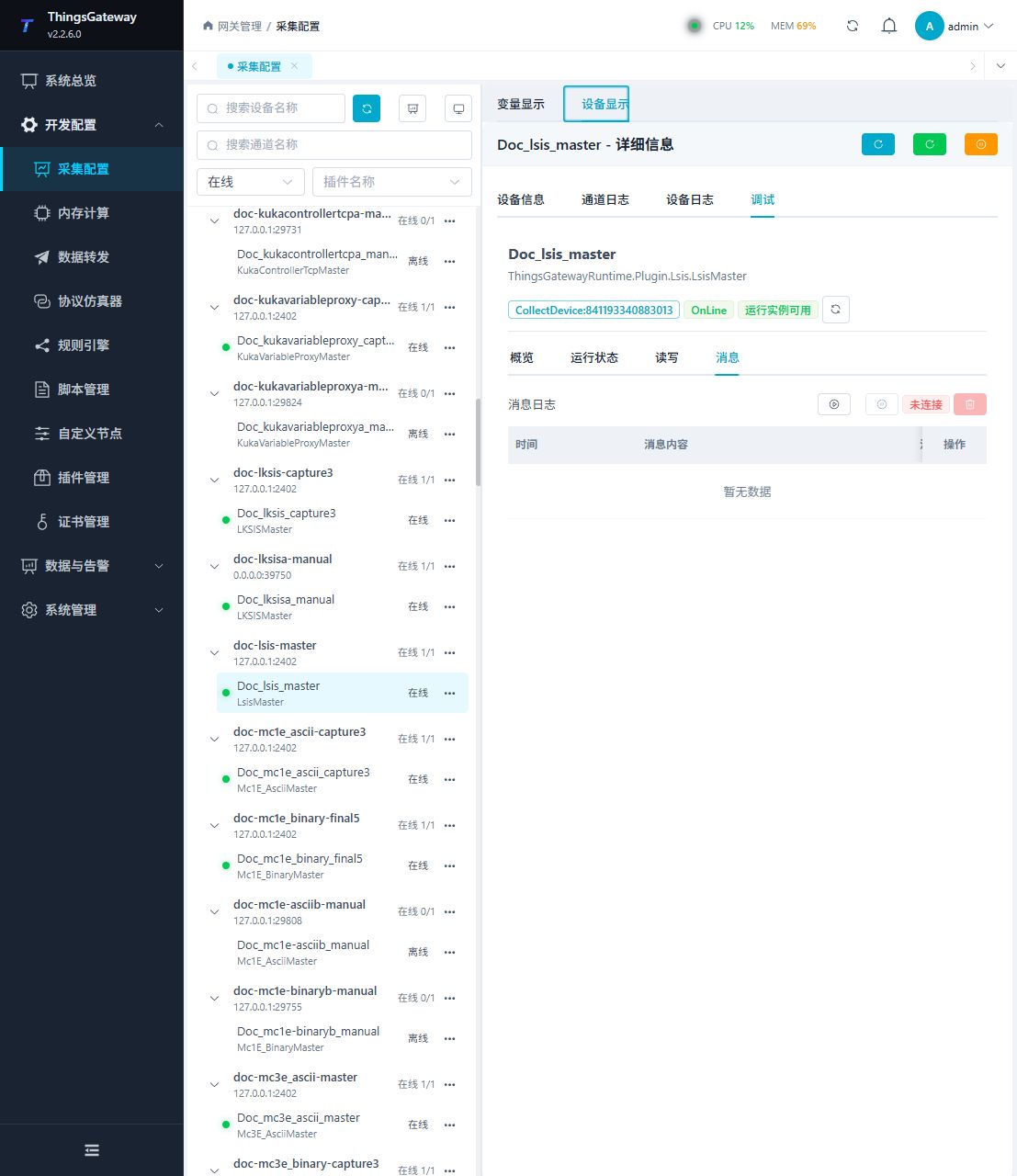
Functions
| Function | Purpose |
|---|---|
| Read and write | Read a confirmed point and write only to an approved test point. |
| Messages | View sent and received frames, protocol fields, and error details. |
Verify the configuration
Monitor DW100 online in the PLC engineering tool, compare its value with the gateway variable and confirm advancing sample times.
Troubleshooting
- Do not mix Fast Ethernet and Cnet frames. Boolean uses forms such as MX10.3 with a hexadecimal bit suffix; WORD uses DW100.
- The serial port device does not respond: Confirm that the serial port is not occupied, and check the baud rate, data bits, stop bits and parity bits.
Related links
- Collection configuration: View channel, device and common variable configuration.
- Plugin Index: Find other collection or data-forward plugins.