On this page
Allen-Bradley SLC Ethernet master
Allen-Bradley SLC Ethernet file table read and write driver
Open the plugin
Enter “Development Configuration → Collection Configuration”, create a device and select “SlcEthernetMaster” in “Collection Plugin”.
Supported channels and data types
| Channel type | Pre-configuration check |
|---|---|
| TCP Client | Confirm network reachability of the device IP, port, and gateway to the device. |
Optional data types: Boolean, Byte, Int16, UInt16, Int32, UInt32, Int64, UInt64, Float, Double, String, Decimal
This list describes types allowed by the plugin editor. Address width, arrays, string length and read/write restrictions still follow this page; it does not mean that every address supports every type.
Address rules
- SLC Ethernet file table address: N7:0, B3:0, F8:0, ST9:0; Boolean uses N7:0/3 or N7:0.3. Read and write 1 to 236 bytes at a time.
Device debug
Enter “Development Configuration → Collection Configuration”, select the current device then open “Protocol Debug” at the top of the workspace.
Read and write
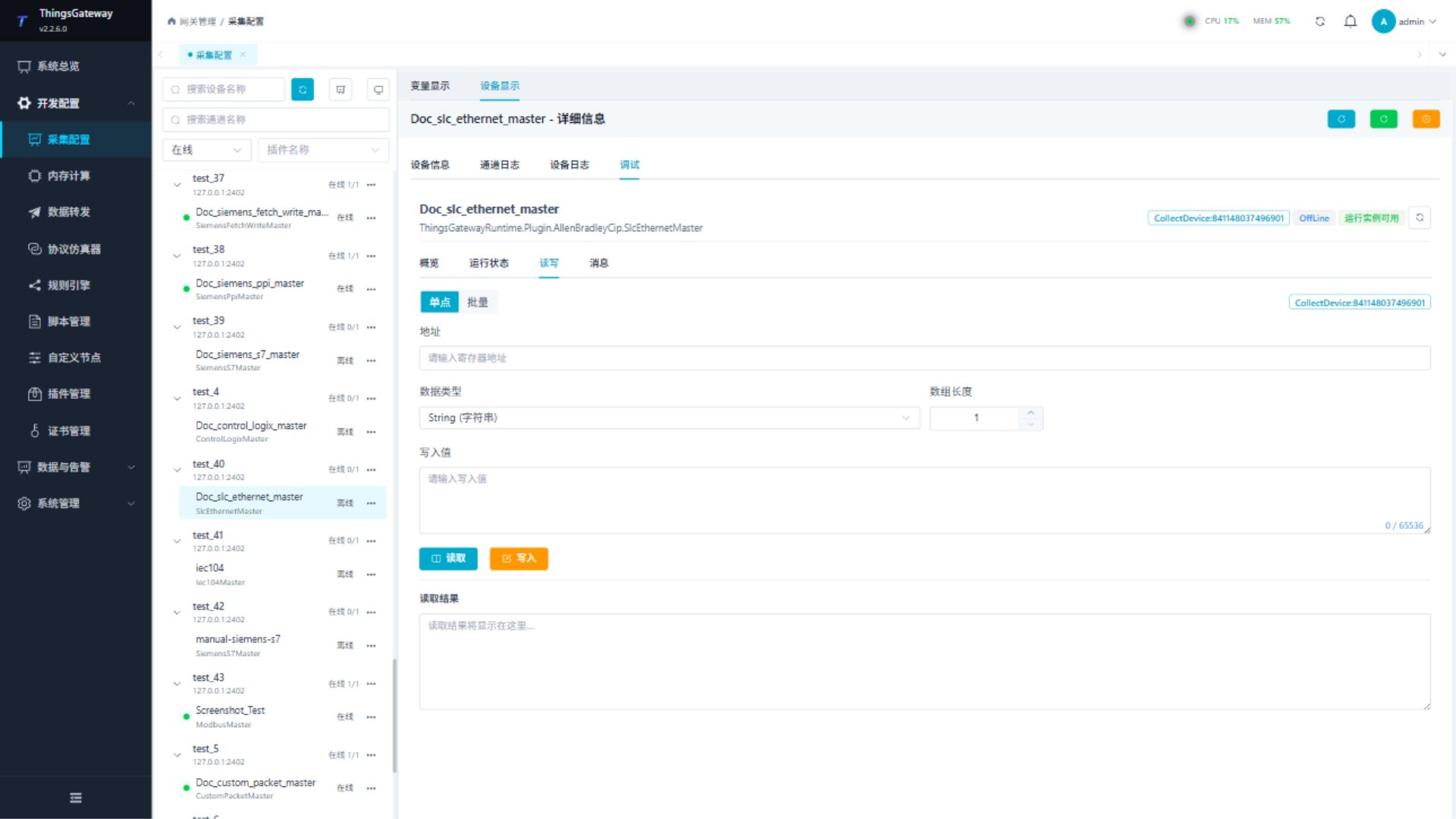
Perform read or write verification according to the current plugin address rules; confirm on-site security and permissions before writing.
Messages
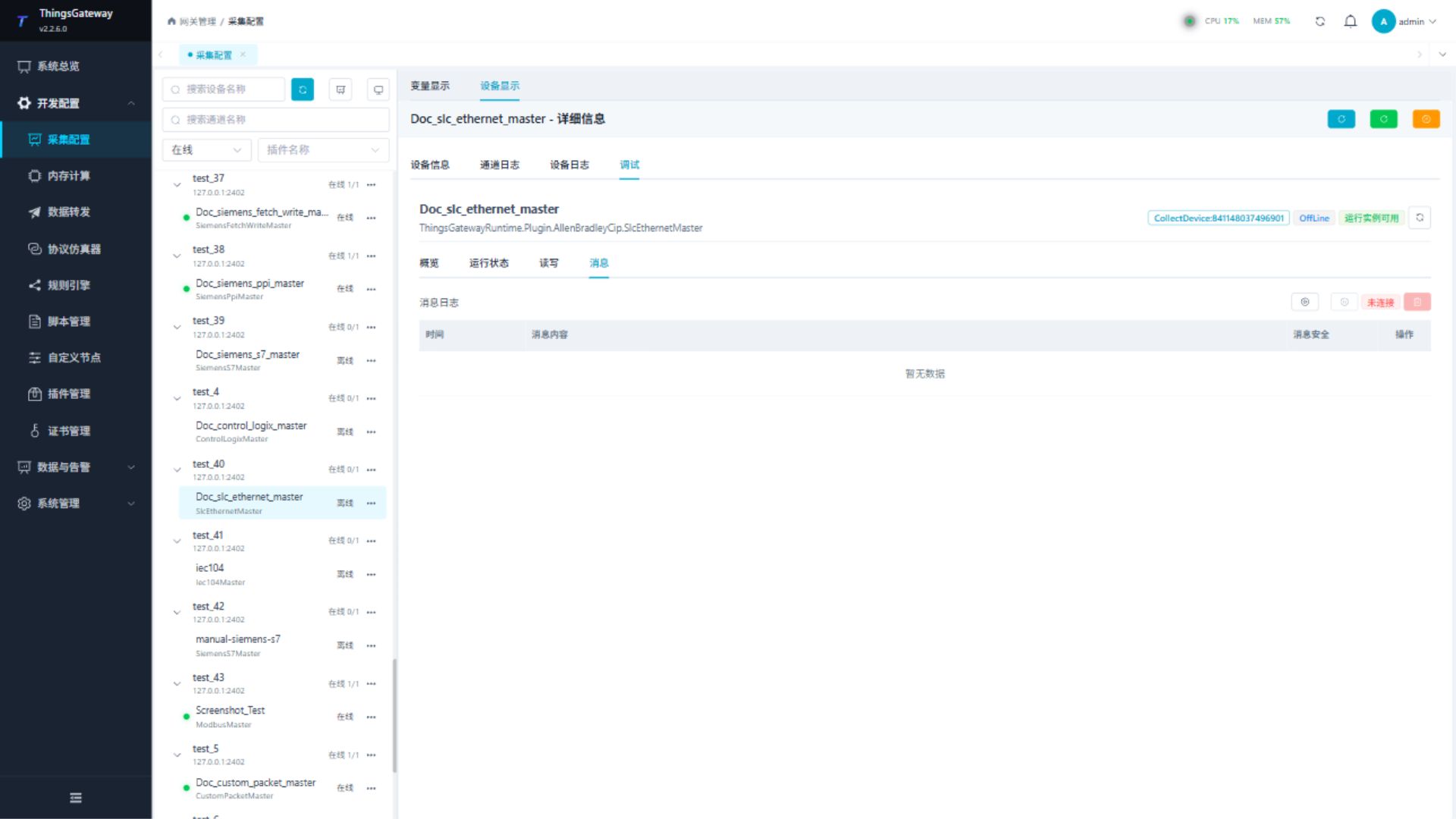
Check the device’s message sending and receiving and protocol logs to locate message format, connection and parsing problems.
Functions
| Function | Purpose |
|---|---|
| Read and write | Read a confirmed point and write only to an approved test point. |
| Messages | View sent and received frames, protocol fields, and error details. |
Verify the configuration
Monitor N7:0 online in the PLC engineering tool, compare its value with the gateway variable and confirm advancing sample times.
Troubleshooting
- Bit access uses forms such as N7:0/3. Payload length is 1–236 bytes; file-table numbers are not CIP tags.
Related links
- Collection configuration: View channel, device and common variable configuration.
- Plugin Index: Find other collection or data-forward plugins.